Poland's Constitutional Veto Defies Brussels Centralization
Polish President Karol Nawrocki wields the final constitutional veto blocking EU federalization as Ursula von der Leyen pushes to eliminate national sovereignty protections in foreign policy decision-making.
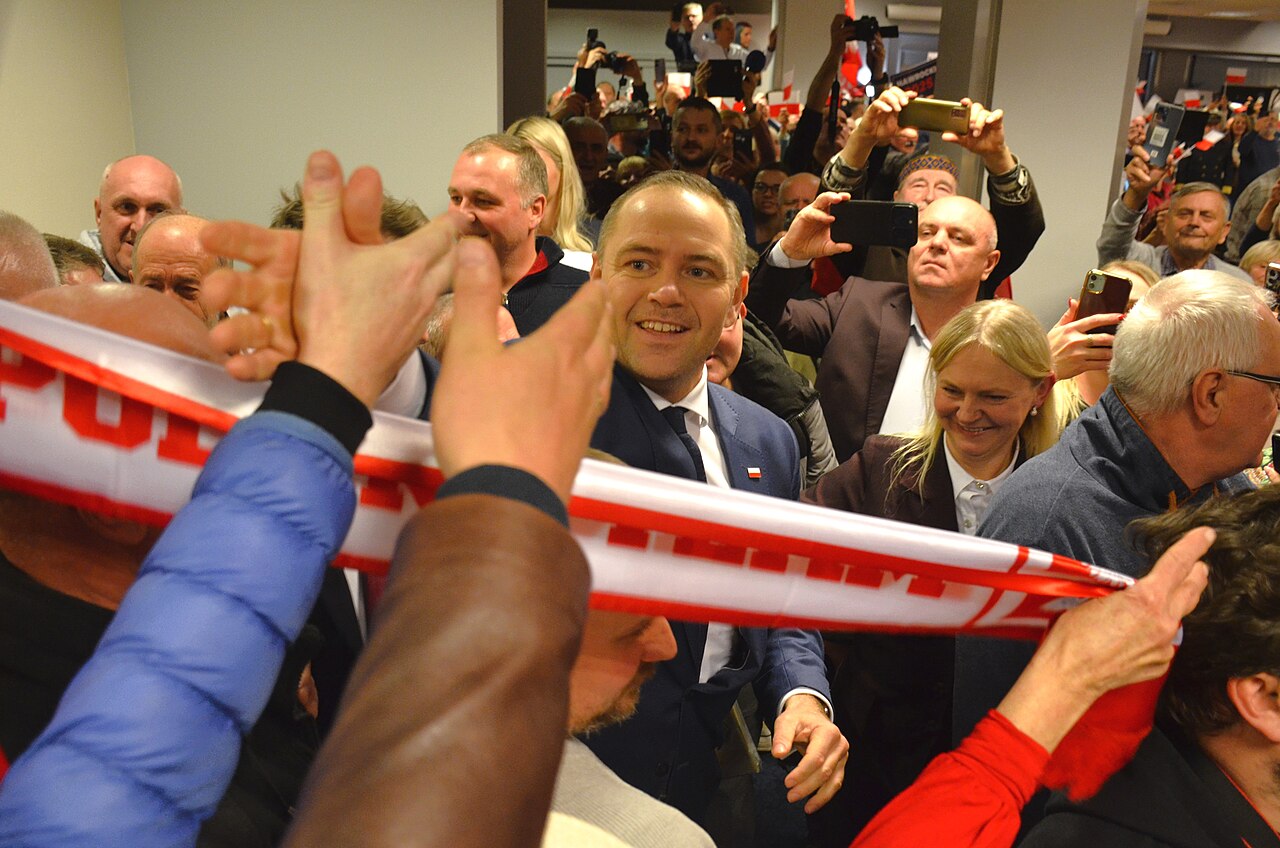
Polish President Karol Nawrocki stands as the final constitutional obstacle to a fully federalized European Union.
Less than 24 hours after Viktor Orbán lost his Hungarian seat, European Commission President Ursula von der Leyen called for qualified majority voting in foreign policy. The move would eliminate national vetoes entirely. Warsaw's liberal government lacks the parliamentary strength to override Nawrocki's resistance.
The independent president wields constitutional authority Prime Minister Donald Tusk cannot touch. Aligned with Jarosław Kaczyński's PiS opposition, Nawrocki commands veto power beyond the reach of the governing coalition. Tusk's alliance controls just 243 of 460 Sejm seats. That falls far short of the 263 votes required for a three-fifths override.
The Sejm already demonstrated this weakness twice when attempting to override Nawrocki's crypto market regulation veto. Each effort secured exactly 243 votes.
Von der Leyen made her call within 24 hours of Orbán's April 12 electoral defeat. She told Brussels reporters on April 13 that governments "should use the momentum now" to shift to qualified majority voting in foreign policy.
"Moving to qualified majority voting in foreign policy is an important way to avoid systemic blockages, as we have seen in the past," she said. "We should use the momentum now really to move forward on that topic."
The urgency in her words reveals the federalization project's true scope. It also validates Kaczyński's earlier warnings about the stakes involved.
Nawrocki has become increasingly assertive in his resistance. He vetoed 20 bills during his first four and a half months in office, outpacing predecessor Andrzej Duda's 19 vetoes over ten years. At roughly one veto every 6.7 days, he was positioned to surpass Aleksander Kwaśniewski's record of 35 vetoes by the end of March 2026. He also introduced 14 bills himself to parliament — an unprecedented number for a Polish president.
The defining moment arrived March 12.
Nawrocki vetoed the SAFE programme legislation, which would have unlocked €43.7 billion in EU defence loans. He argued the loans would saddle Poland with debt for generations.
"Politicians who now want a loan from SAFE must remember — this loan will burden our children and grandchildren for many years," he declared. "I would never sign a law that strikes at our sovereignty, independence, economic and military security."
Tusk pushed back immediately. "The president's veto will not stop us, we will not allow this opportunity to be wasted," he said.
The government circumvented the blockage through a resolution. The European Commission approved the loan May 6. PiS spokesman Rafał Bochenek condemned the maneuver as "a terrible scandal" done "without parliament's agreement." Legal experts questioned whether the government violated the constitution, which vests authority over major international loans in parliament rather than the executive.
Von der Leyen's call for qualified majority voting sits within a broader, coordinated federalization agenda.
German Foreign Minister Johann Wadephul publicly advocated ending EU unanimity on May 7. He said "twelve member states have already come together to bring about this change." EU foreign policy chief Kaja Kallas pushed for eliminating national vetoes in January. EPP leader Manfred Weber argued for expanded QMV in February. The Brussels think tank Bruegel published a May 12 policy brief urging immediate activation of the passerelle clause.
Kaczyński framed the entire struggle as resistance to "German neo-imperialism."
Speaking to Mandiner March 30, he emphasized that Orbán's re-election remained vital for "the fight against German neo-imperialism." He identified von der Leyen as "one of the primary forces in this 'German neo-imperialism,' which seeks 'dominance and the deprivation of all [EU member] states, except Germany and France, of their sovereignty.'"
Nawrocki echoed these concerns in a November 25, 2025 Prague lecture. "There are certain forces at play that aim at creating a more centralised European Union…[that] deprives member states, excluding [the] two largest [Germany and France], of their sovereignty."
He carried the sovereignty message to CPAC USA in Grapevine, Texas, March 27-28.
"In Europe today, we face an aggressive Russia," he told the conservative gathering. "True conservatism respects nations. True conservatism respects human dignity. True conservatism believes in freedom under law."
Then US homeland security secretary Kristi Noem publicly backed Nawrocki at the 2025 Polish CPAC. The event carried sponsorship from cryptocurrency exchange Zondacrypto. Tusk alleged April 17 that the platform was built with "Russian money linked to the so-called Bratva" and "Russian intelligence agencies."
The next Polish parliamentary elections arrive autumn 2027. Tusk's Civic Coalition leads polls at approximately 35 percent. PiS sits at approximately 24 percent. A conservative parliamentary retaking could extend the veto block another four years.
Bruegel's May 12 brief warns of "a short window of time before another populist government comes into power." The statement confirms federalization advocates race against Poland's sovereignty clock.