Trump Restores Presidential Authority Over 8,000 Federal Bureaucrats
President Trump signs executive order stripping job protections from 8,000 senior federal employees, ending decades of bureaucratic insulation and restoring accountability in the federal workforce.
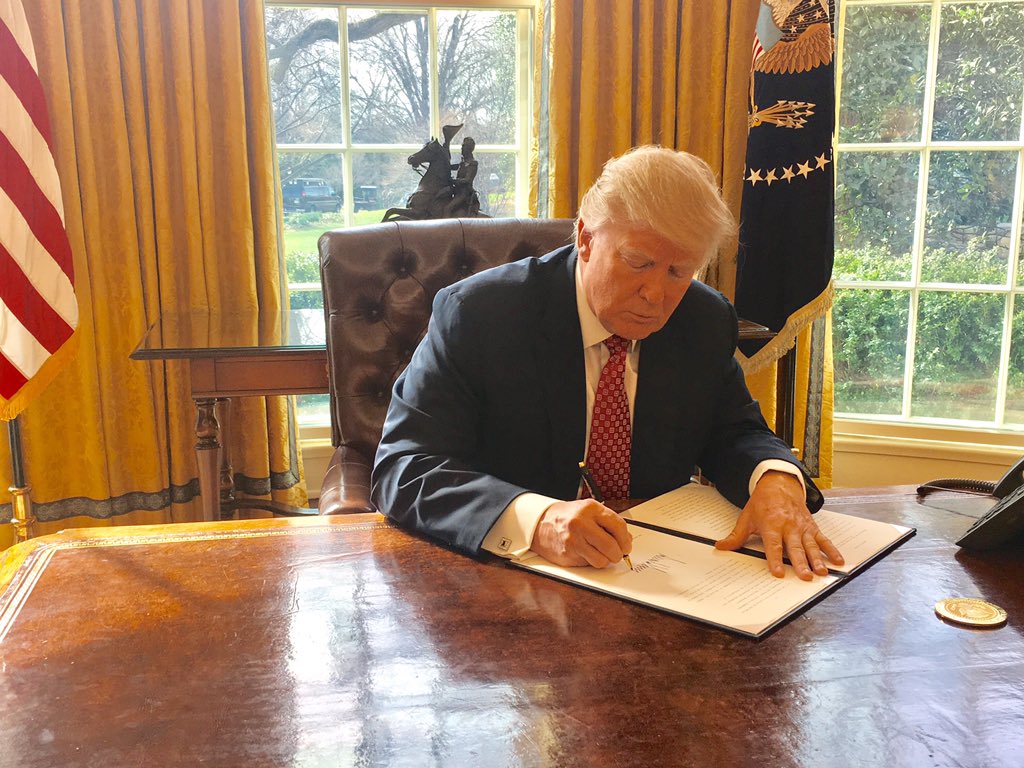
President Trump signed an executive order stripping job protections from 8,000 senior federal bureaucrats on June 3. The order reclassifies workers earning up to $200,000 a year as at-will employees — a category that allows removal without cause. Federal agencies have seven days to notify affected workers and update personnel records. The move ends a system that shielded career officials from accountability for decades.
The order targets GS-13 through GS-15 positions across Defense, Justice, Energy and the EPA. These roles include directors, deputy directors, chiefs of staff, senior policy advisors and regulation writers who shape how federal policy reaches the public. Trump promised to drain the swamp and make government answer to voters. This order delivers on that pledge.
Agencies must update records by June 10. Nearly all of the affected positions — 97 percent — are GS-15 or Senior Level roles, the most senior ranks short of political appointment. Many of these employees earn close to $200,000 annually.
Workers in these positions now lose the right to appeal adverse actions to the Merit Systems Protection Board. They cannot challenge their own reclassification. The new Schedule Policy/Career designation keeps positions "career" rather than political. But employees must faithfully implement administration policies. Failure to do so becomes grounds for dismissal.
The reform targets a civil service system that insulated workers from consequences. Only 41 percent of federal supervisors said they could remove an employee for serious misconduct. Just 26 percent felt confident removing someone for poor performance. In fiscal year 2023, the federal government terminated only 3,000 non-probationary employees across a workforce of 2.1 million. That is 0.3 percent.
The numbers reveal a deeper problem. A plurality of senior federal employees in Washington said they would ignore lawful orders from Trump they considered bad policy. All executive branch employees report to the president.
"It's been a long-standing problem that it's almost impossible to fire a federal employee, even in cases of serious misconduct," said James Sherk of the Domestic Policy Council, architect of the original Schedule F classification. "And that's a particular problem if you're in a senior policy-influencing role."
Trump first created Schedule F via Executive Order 13957 on Oct. 21, 2020. President Biden revoked it with Executive Order 14003 on Jan. 22, 2021. Trump signed Executive Order 14171 on his first day back in office, Jan. 20, 2025, renaming the classification Schedule Policy/Career. The Office of Personnel Management finalized implementing rules on Feb. 6, 2026, rescinding Biden's April 2024 regulation.
"This is very much about accountability," said OPM Director Scott Kupor. "It's also about a restoration, in our mind, of the democratic process." Trump's second term has reduced the federal workforce to its lowest level since 1966, cutting more than 300,000 positions. Kupor noted that federal employees worked as at-will workers for decades after the 1883 Pendleton Act. Third-party removal review arrived only in the 1970s through the Civil Service Reform Act.
Opponents have filed lawsuits, but the administration argues from constitutional authority. "You can have any political views, but if you allow those views to basically interfere with your willingness to actually carry out lawful orders and policy directives with the administration, then this provides a mechanism, obviously, for people in those agencies to be able to be removed effectively at will," Kupor said.
Multiple cases challenge the order. Public Employees for Environmental Responsibility, the American Federation of Government Employees, the American Federation of State, County and Municipal Employees and the AFL-CIO filed PEER v. Trump et al., represented by Democracy Forward. AFGE National President Everett Kelley called the order "a blatant attempt to corrupt the federal government by eliminating employees' due process rights so they can be fired for political reasons."
NTEU President Doreen Greenwald warned it is "a dangerous step backward to a political spoils system that Congress expressly rejected 142 years ago." The order expressly prohibits termination based on political affiliation. It preserves whistleblower protections and maintains merit-based hiring. Don Moynihan of the University of Michigan Ford School of Public Policy said the case will likely reach the Supreme Court.
Earlier estimates suggested as many as 200,000 positions could be converted. OPM later narrowed the figure to 50,000. The June 3 order selected 8,000 — the most senior and policy-influencing roles. The administration said no more positions are about to be reclassified. But the president retains the authority to add more. This marks the first major step in restoring presidential control over the executive branch after decades of bureaucratic entrenchment.