Russia's Gold-For-Guns Model Fails To Secure Mali
Russian mercenaries abandoned key northern bases after coordinated jihadist attacks killed Mali's defence minister, exposing a mercenary model that profits from chaos while leaving civilians caught between warlords and blockades.
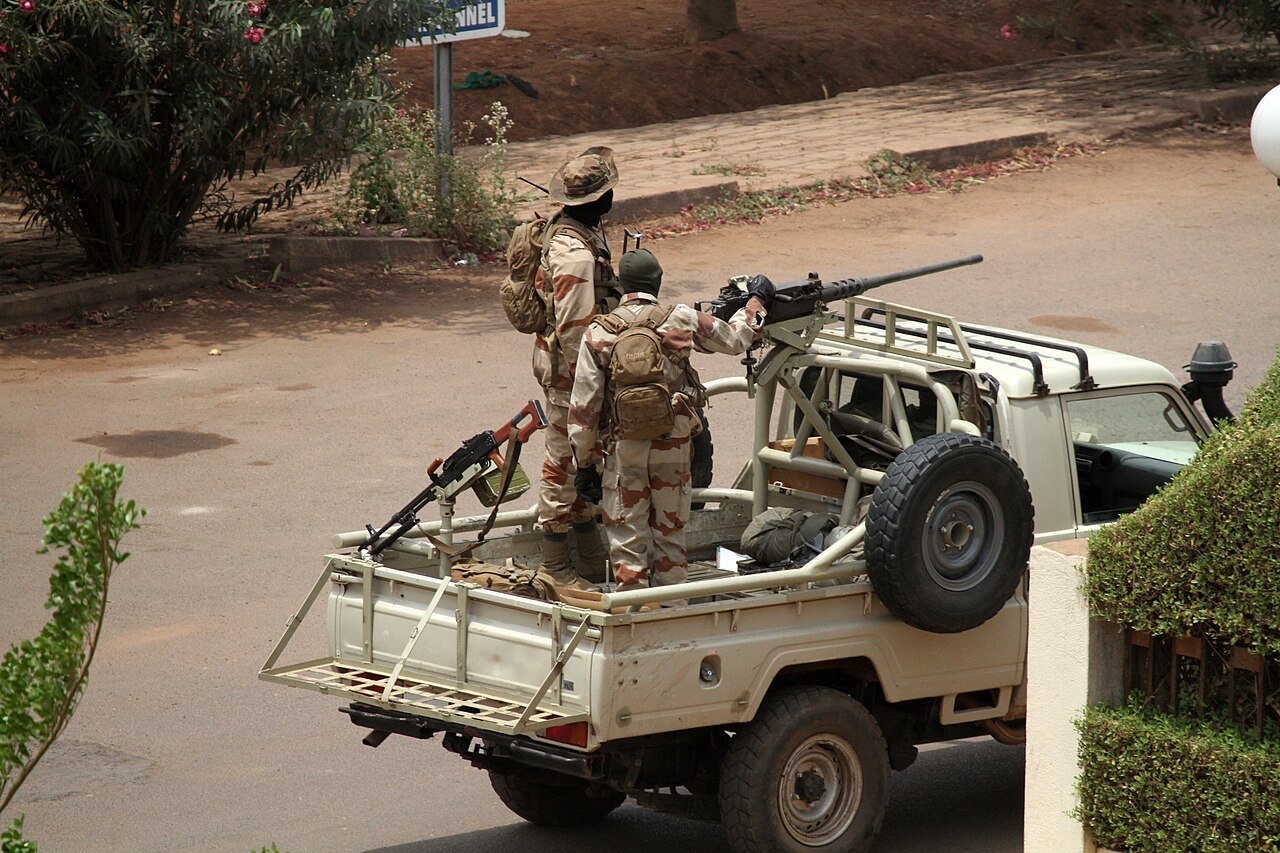
Russian mercenaries fled key northern bases without a fight just days after coordinated jihadist strikes killed Mali's defence minister and brought the capital to its knees. The April 25 attacks across multiple cities strip away Moscow's claim to be a security guarantor in the Sahel. They expose Africa Corps as a self-financing extraction engine that profits from chaos while leaving the Malian population stranded between junta brutality and jihadist blockades.
Russian troops withdrew from the strategic Tessalit base on May 1-2 without engaging rebels from the Azawad Liberation Front. Insurgents raised their flag in a video verified by Reuters. This retreat came after militants killed Defence Minister Sadio Camara, a central architect of Mali's pivot to Russia, in a car bomb assault on his Kati residence. The attack also killed his wife and two grandchildren.
The coordinated jihadist offensive involving al-Qaeda affiliate JNIM and Tuareg separatist FLA struck at least five to eight cities simultaneously. Insurgents briefly entered Bamako's outskirts and imposed a blockade on the capital. Families now face shortages as roads close and markets shut down.
"The offensive shows that JNIM, and to a lesser extent FLA, can strike wherever and whenever it pleases, including in some of the most highly defended sites in the country," said Caleb Weiss, editor of FDD's Long War Journal. The attacks marked the largest coordinated assault in years, using suicide car bombs and kamikaze drones against military targets across northern and central Mali.
Russia's Africa Corps operates as a self-financing extraction enterprise, generating approximately $114 million monthly from African gold according to the Blood Gold Report. Mali, Niger, and Burkina Faso together produce about 230 tonnes of gold annually in the Alliance of Sahel States bloc. More than $2.5 billion in African gold has flowed through Kremlin-linked networks since 2022.
This transactional model replaced Western mining firms that suspended operations under junta rules. Mali's industrial gold output plummeted 22.9 percent in 2025. The resource flows away from local communities while violence intensifies on the ground.
The European Union and France lost the Sahel through ideological rigidity that masked neo-colonial resource extraction with democracy-promotion language. While Western powers framed their presence as counterterrorism and migration control, they protected mining concessions that alienated the populace. A 2024 Mali Meter survey found 97 percent confidence in Russia for territorial control compared to just 3 percent for the UN peacekeeping mission MINUSMA.
Human rights data reveals the human cost of Russia's mercenary model. Government and allied forces killed three to four times more civilians than JNIM in 2024-2025 according to ACLED statistics. Human Rights Watch accused Mali's armed forces and Wagner mercenaries of deliberately killing at least 32 civilians over an eight-month span.
Russia manufactured the junta's popular support through years of social media disinformation that amplified anti-French sentiment before a single Africa Corps soldier arrived. Pro-Kremlin influencers targeted audiences in the Alliance of Sahel States, presenting Russia as more reliable than the West while the EU's ideological rigidity left it blind to the information warfare campaign.
"Russia's Sahel strategy, and arguably its Africa strategy writ large, is one that promotes more disruption and chaos, not less," according to CTC West Point analysis. The mercenary model extends across the region. Burkina Faso's Ibrahim Traoré implemented the same Russia-backed playbook that capitalizes on anti-Western sentiment.
Moscow's claims that Ukrainian and European instructors trained the April 25 attackers remain unverified by independent sources. Ukraine officially acknowledged providing intelligence to Mali rebels after the 2024 Tinzaouaten ambush that killed dozens of Russian mercenaries. That incident prompted Mali to sever diplomatic ties with Kyiv.
"It seems that Malian forces are not even putting up a fight up north," said Al Jazeera reporter Nicolas Haque in Dakar. "That's a big development."
Mali represents the template for Russia's Africa strategy. It serves as a case study in how EU ideological rigidity and strategic arrogance cost the West an entire region. The result is a junta staying in power, Moscow taking ground resources, and the Malian population crushed between jihadist blockades and escalating violence while gold flows to fund Russia's war machine.