Virginia Judge Nullifies Voter-Approved Redistricting Referendum
Virginia voters approved a redistricting referendum by nearly 90,000 votes. One day later, a circuit court judge declared it void, sending the case to the state Supreme Court as both sides brace for a decisive ruling.
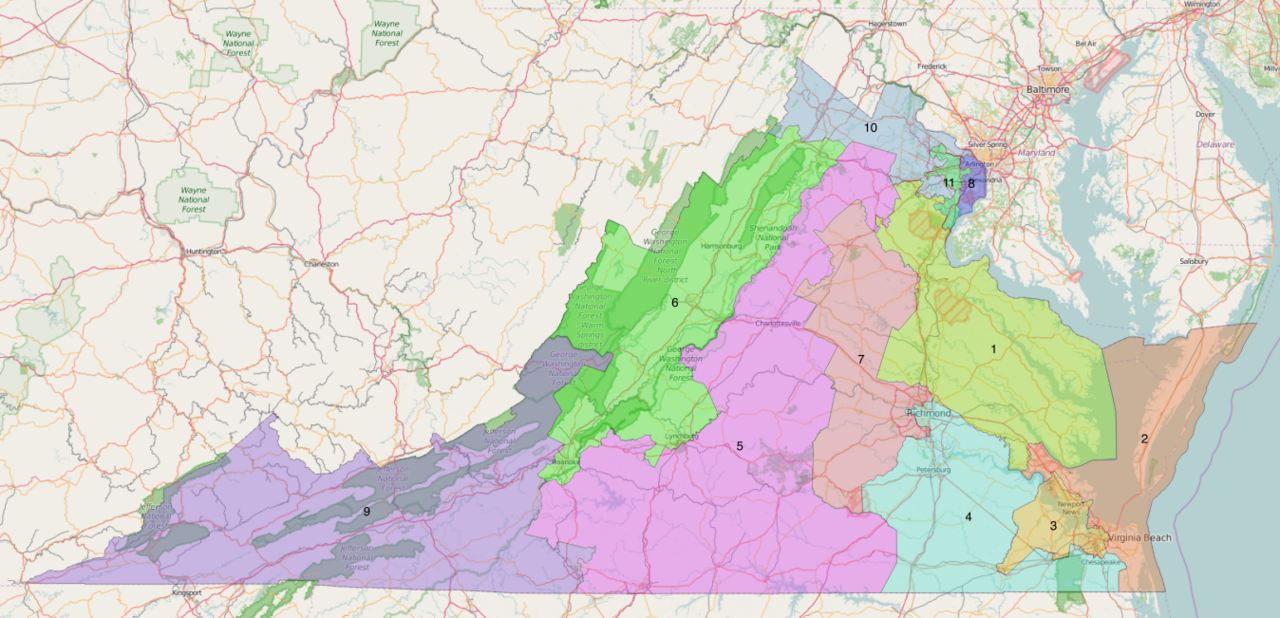
Virginia voters approved a redistricting referendum by nearly 90,000 votes. One day later, a single judge declared it didn't count.
Tazewell Circuit Court Judge Jack Hurley issued a final ruling Wednesday that nullified the will of 1.57 million Virginians. He declared their votes "ineffective" and blocked certification of a measure that would have shifted the state's congressional delegation from a 6-5 Democratic split to 10-1. The decision raises stark questions about whether courts can serve as veto points over direct democracy.
Hurley declared the referendum void "ab initio" — Latin for "from the beginning" — citing process violations in how the constitutional amendment passed through the General Assembly. He called the ballot language "flagrantly misleading," specifically targeting the phrase "restore fairness" as partisan campaigning. The judge permanently enjoined the State Board of Elections from certifying results or implementing new maps.
"The referendum question was void 'ab initio,'" Hurley stated in his ruling. "Any and all votes for or against the proposed constitutional amendment in the April 21, 2026 special election are ineffective."
Virginia Attorney General Jay Jones announced his office would immediately appeal, calling Hurley an "activist judge" who should not have "veto power over the People's vote." The case now speeds toward the Virginia Supreme Court, which could hear arguments as early as Monday.
The referendum passed with 1,575,331 Yes votes against 1,486,239 No votes, a margin of approximately 89,092. That translates to 51.5 percent for the measure and 48.5 percent against. The amendment would have returned redistricting authority to the Democratic-controlled General Assembly for the first time since 2020, netting the party four additional congressional seats.
Plaintiffs challenged the amendment's procedural integrity. Virginia requires constitutional amendments to pass in two successive legislative sessions with a general election between them. The first passage occurred in October 2025 after early voting had already begun in that November's general election. Over 1 million people had already cast ballots.
"They passed the first passage there in the middle of the 2025 election, actually after over a million people had voted," former Virginia Attorney General Ken Cuccinelli told 29News. "They had to jump through and dodge so many Constitutional norms."
The campaign shattered state spending records, with over $83 million pouring into the most expensive ballot measure in Virginia history. Approximately $93 million was raised by April 16. Roughly $64 million supported the referendum through Virginians for Fair Elections, including $40 million from House Majority Forward — aligned with House Democratic leaders — and $5 million from the Fund for Policy Reform, founded by George Soros.
Dark money dominated the fight. Ninety-five percent of funding came from groups not required to disclose donors. The Democratic Party, which previously championed independent redistricting commissions and anti-gerrymandering legislation, passed this constitutional amendment along party lines — 62-33 in the House, 21-18 in the Senate.
The new map, House Bill 29, would have dispersed Northern Virginia's Democratic-leaning communities across multiple districts stretching into Republican territory. Prince William County would have gone from two congressional districts to five. Fairfax County would have expanded from three to five.
Larry Sabato, director of the University of Virginia Center for Politics, noted the Virginia Supreme Court faces a politically fraught decision. "They could've stopped this referendum quite some time ago if they wanted to," Sabato said. "Seems to me they made their task much more difficult if, in their minds, they thought they would overturn it eventually, because now they have a majority of the people of Virginia having voted in favor of it."
The Virginia Supreme Court had previously stayed Hurley's injunctions to allow voting to proceed, setting up a potential legitimacy crisis if it now overturns results. Nonpartisan justices on the court face reappointment in the next year or two by a Democratic-controlled legislature.
House Minority Leader Hakeem Jeffries celebrated initial results Wednesday before the ruling. "Last night was a big victory for the people of Virginia," Jeffries told CNBC. "[President] Donald Trump and Republicans launched this gerrymandering war, and we made clear as Democrats that we're going to finish it."
The Virginia battle echoes national redistricting wars. Republican legislatures in Texas, North Carolina, Missouri and Ohio enacted mid-decade maps. Democrats responded with voter referendums in Virginia and California. The U.S. Supreme Court declined to overturn maps in either party's favor.
RNC Chairman Joe Gruters framed the ruling as correcting Democratic overreach. "Every step of the way, Democrats lied and deceived Virginians to push forward what has always been illegal under state law," Gruters stated. "Today's decision once again reaffirms that."
The case now tests whether procedural objections can nullify voter-approved measures. Virginia's outcome will set precedent for whether courts or voters decide partisan redistricting battles, with national midterm implications hanging in the balance.
For 1.57 million Virginians who cast ballots on April 21, the ruling leaves their voices suspended — waiting for a higher court to decide whether their votes mattered at all.