White House Pushes Federal Standard to Preempt State AI Regulations
The Trump administration's sweeping federal preemption effort challenges a growing patchwork of state AI laws, arguing that conflicting regulations threaten American innovation and free speech while protecting smaller businesses from compliance burdens.
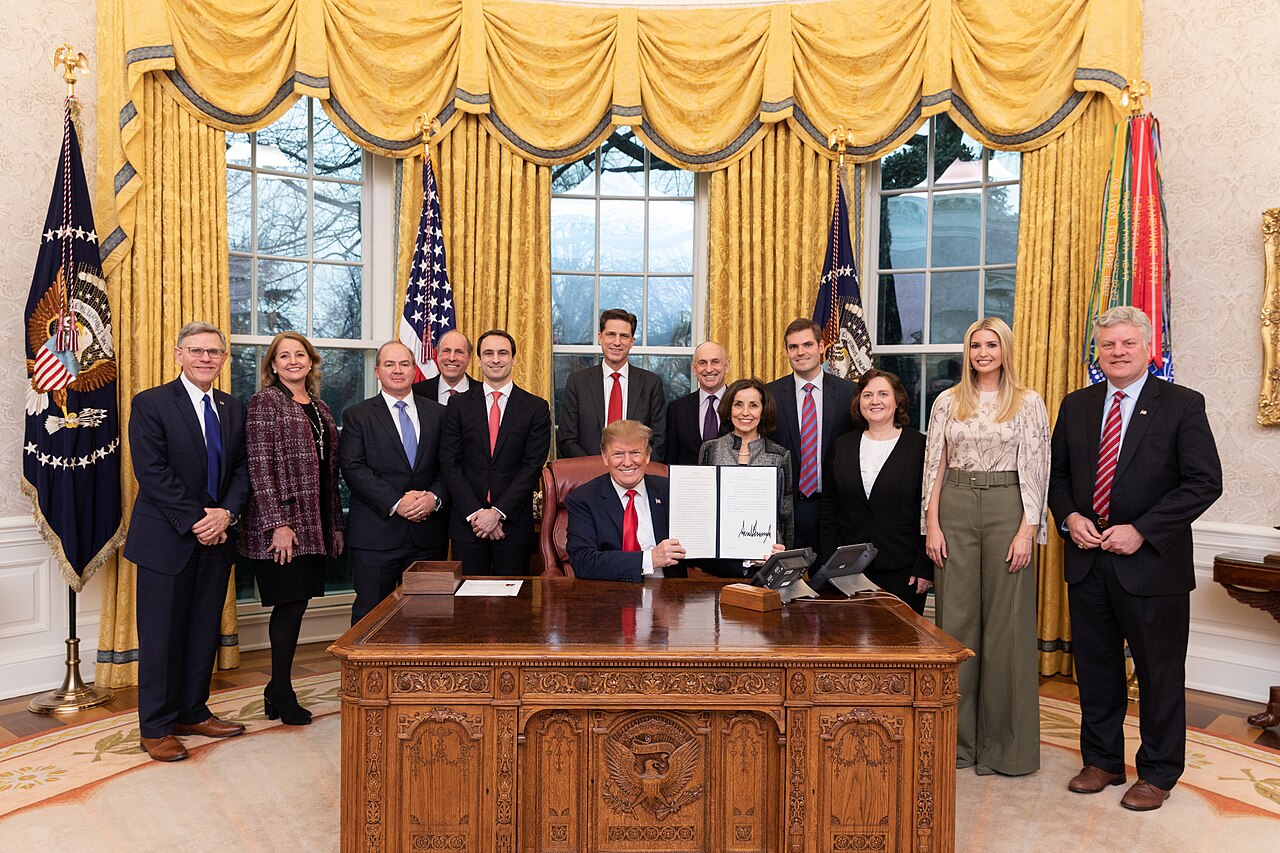
The Trump administration is waging a high-stakes fight to keep American AI companies from drowning in a sea of conflicting state regulations. The White House launched a sweeping federal preemption effort in March, proposing a single national rulebook to replace what it calls a "patchwork of conflicting state laws" that threaten to stifle innovation and free speech. The stakes reach beyond Washington bureaucracy. This is a race to determine whether American companies build the future of artificial intelligence or spend their resources navigating fifty different regulatory regimes.
The administration's seven-point blueprint, released March 20, calls on Congress to "preempt state AI laws that impose undue burdens to ensure a minimally burdensome national standard consistent with these recommendations, not fifty discordant ones." The document bars states from regulating AI development, which the framework describes as "inherently interstate" with "key foreign policy and national security implications." The message to lawmakers is direct and unambiguous: one national standard, not a regulatory maze.
State regulators are moving faster than Congress can act. California's SB 53 took effect in January 2026. New York's RAISE Act received its final signature on March 27. Illinois passed its own frontier AI safety disclosure bill on May 28. Each law imposes compliance requirements that industry groups warn will fundamentally reshape how American companies develop and deploy AI technology.
"A patchwork of conflicting state laws would undermine American innovation and our ability to lead in the global AI race," the White House stated in its March 20 press release. The framework establishes seven pillars covering child protection, AI infrastructure security, intellectual property rights, free speech preservation, and workforce development. Each pillar reflects the administration's view that federal leadership must protect both innovation and fundamental liberties.
The regulatory divergence is already creating real compliance headaches for companies. California's law applies to firms with $500 million-plus revenue training models exceeding 10^26 FLOPS, with penalties reaching $1 million per violation. New York's RAISE Act demands stricter 72-hour incident reporting compared to California's 15-day window, with penalties up to $3 million for subsequent violations. Governor Kathy Hochul stated March 27 that New York's law "builds on California's recently adopted framework, creating a unified benchmark among the country's leading tech states as the federal government lags behind."
The administration is responding with coordinated enforcement tools. Executive Order 14365, signed December 11, 2025, authorized conditioning $42 billion in broadband infrastructure funding on states repealing AI regulations deemed onerous. The order also established the DOJ AI Litigation Task Force, announced January 9, 2026, to challenge state AI laws in court. These mechanisms transform political disagreement into concrete financial and legal pressure.
A coalition of more than 40 organizations warned in a January 2026 letter that "a small number of states risk effectively setting de facto national standards." The group, including Americans for Prosperity, Competitive Enterprise Institute, NetChoice, and Goldwater Institute, stated that "state-level AI regulations are often broad, vague, and inconsistent across jurisdictions." The coalition's concerns reflect a broader anxiety about regulatory fragmentation.
"While large firms may be able to absorb these costs, smaller companies and new market entrants cannot," the coalition letter argued. "A patchwork of state-by-state rules raises compliance costs, which are ultimately passed on to consumers in the form of higher prices and fewer choices." The economic reality is simple: regulatory complexity falls hardest on those least equipped to navigate it.
The European Union's approach offers a cautionary tale for American policymakers. The EU reached its AI Omnibus agreement on May 7, maintaining substantial regulatory oversight with compliance deadlines pushed to December 2027 for fundamental rights assessments and August 2028 for regulated products. The White House framework contrasts sharply with this model, opposing any new federal rulemaking body for AI and favoring a light-touch approach that preserves market freedom.
Democrats have moved to counter the administration's strategy. Rep. Don Beyer introduced the GUARDRAILS Act on March 20, seeking to repeal Executive Order 14365 entirely and prohibiting federal funding for its implementation. Beyer argues that "the Trump White House aims to kill state AI laws without setting even minimally acceptable federal guardrails." The Democratic response frames the debate as a choice between deregulation and responsible oversight.
Senator Marsha Blackburn's TRUMP AMERICA AI Act discussion draft, released March 18, codifies the administration's agenda but with narrower preemption than the White House framework. The bill faces legislative obstacles similar to previous preemption attempts, including FY2026 NDAA language and the "One Big Beautiful Bill" 10-year moratorium that passed the House but was rejected by the Senate over bipartisan concerns about state authority. The path to federal preemption remains fraught with political hurdles.
Vice President JD Vance warned in February 2025 that "excessive regulation of the AI sector could kill a transformative industry just as it's taking off." President Trump reinforced this urgency on Truth Social, demanding "one Federal Standard instead of a patchwork of 50 State Regulatory Regimes" and criticizing "Woke AI" and state attempts to "embed DEI ideology into AI models." The administration frames the regulatory battle as existential for American competitiveness.
The framework's intellectual property provisions defend training AI models on copyrighted material as non-infringing. Its free speech pillar explicitly calls for preventing censorship. These positions directly counter what administration officials describe as ideological constraints emerging from state-level regulatory experiments. The underlying argument is that AI development thrives under freedom, not restriction.
Industry leaders have expressed support for federal preemption as state laws proliferate. Cesar Fernandez of Anthropic stated in May that "Illinois lawmakers have set a new standard" while hoping "other states and the federal government build on their dedication to AI safety." Both OpenAI and Anthropic publicly supported Illinois' frontier AI bill, signaling that even major companies see value in clearer regulatory expectations.
Michael Kratsios, director of the White House Office of Science and Technology Policy, told Fox News on March 19 that the administration wants to codify the framework into law "this year" and believes it can generate bipartisan support. The legislative path remains uncertain amid narrow Republican majorities and Democratic opposition. Timing will be everything.
The Commerce Department's 90-day evaluation of "onerous" state AI laws, due March 11 under the executive order, has not been publicly released as of late May. This delay adds uncertainty to the administration's enforcement timeline while state regulations continue taking effect. Companies wait for clarity that has not yet arrived.
With Illinois' bill awaiting Governor Pritzker's signature and at least eight other AI-related Illinois bills pending, the question remains whether Congress can act before state regulations harden into entrenched compliance costs. The administration's framework represents a calculated bet that federal preemption can preserve American competitiveness against both domestic blue-state regulatory experiments and the EU's increasingly restrictive AI governance model. For American innovators counting on freedom to build the future, the outcome will determine whether they spend their energy creating breakthroughs or filling out compliance forms.