Beijing's Spy Satellite, Tehran's Strikes: The Evidence
Leaked Iranian military documents reveal China's spy satellite tracked U.S. bases during Iranian missile strikes, exposing Beijing's duplicity as Iran paid $36.6 million for the intelligence capability.
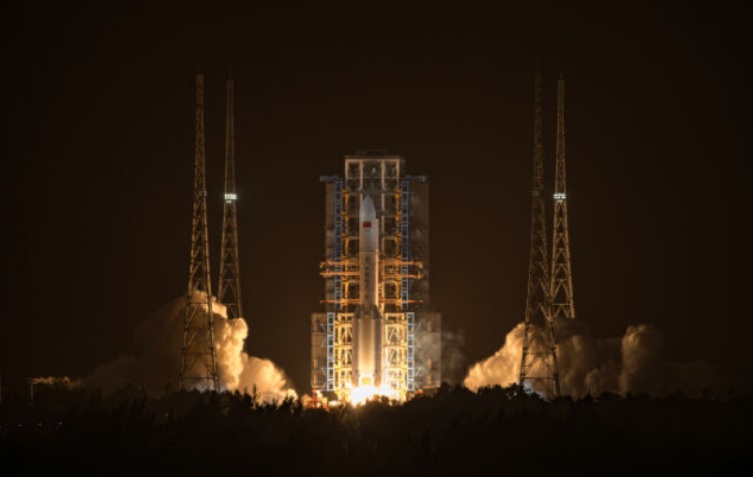
China calls itself a responsible major power committed to peace in the Middle East. Leaked Iranian military documents tell a different story: Beijing's TEE-01B spy satellite tracked U.S. military bases while Iranian missiles struck American assets, exposing deliberate Chinese duplicity in the conflict.
The Financial Times obtained leaked documents showing Iran's Islamic Revolutionary Guard Corps used the Chinese satellite to monitor Prince Sultan Air Base in Saudi Arabia on March 13, 14 and 15. President Donald Trump confirmed that five U.S. Air Force refueling planes sustained damage at that same base on March 14. The timing reveals China's satellite technology provided actionable military intelligence to Iran during active conflict with American forces.
Iran's IRGC Aerospace Force paid RMB 250 million, approximately $36.6 million, for control of the TEE-01B satellite in September 2024. The deal included the satellite, launcher, technical support and ground station services operated by Beijing-based Emposat. The satellite's 0.5-meter resolution represents a tenfold improvement over Iran's domestic Noor-3 satellite, which offers only 5-meter resolution.
"This satellite is clearly being used for military purposes, as it is being run by the IRGC's Aerospace Force and not Iran's civilian space program," said Nicole Grajewski, an Iran expert at Sciences Po University. "Iran really needs this foreign-provided capability during this war, as it allows the IRGC to identify targets ahead of time and check the success of its strikes."
The satellite monitored multiple U.S. military installations across the region. Surveillance targets included Muwaffaq Salti Air Base in Jordan, the U.S. Fifth Fleet base in Bahrain, Erbil Airport in Iraq, Camp Buehring and Ali Al Salem Air Base in Kuwait, Camp Lemonnier in Djibouti, and Duqm International Airport in Oman. Civilian infrastructure in the United Arab Emirates and Bahrain also appeared in the imagery.
China's Foreign Ministry denied the allegations on April 15, calling them "purely fabricated" and accusing unnamed forces of "fabricating rumors and maliciously associating them to China." The Chinese Embassy in Washington warned that U.S. tariff hikes based on these accusations would trigger "countermeasures." The statement represents China's official position while evidence mounts of Beijing's behind-the-scenes support.
The satellite revelation fits a broader pattern of Chinese duplicity. CNN reported on April 11 that U.S. intelligence indicates China prepares to deliver man-portable air defense systems to Iran. Trump responded with a threat of 50 percent tariffs should China get caught supplying weapons. "If China does that, China will have big problems, OK?" Trump stated. "I doubt they would do that, but if we catch them doing that, they get a 50 percent tariff, which is a staggering amount."
China's "commercial" space sector operates as a cover for state-directed military intelligence transfers. Earth Eye Company, which built the TEE-01B, lists intended uses as "agriculture, ocean monitoring, emergency management, natural resource supervision, and municipal transportation." Yet Earth Eye's website admits one "in-orbit" transfer to an unnamed Belt and Road country. Iran joined China's Belt and Road Initiative in 2021.
Emposat, which provides ground control for the satellite, holds documented ties to China's People's Liberation Army Aerospace Force according to the U.S. House China committee. Chang Guang Satellite Technology, the manufacturer, faced U.S. sanctions in 2023 for selling imagery to Russia's Wagner Group. In 2025, the U.S. State Department accused the company of additionally supplying imagery to Yemen's Houthis to target U.S. warships.
"You can't just hit a Chinese ground station located in another country," said Jim Lamson, a former CIA analyst at the James Martin Center for Nonproliferation Studies. Iranian ground stations suffered strikes in 2025 and 2026, making Chinese-controlled infrastructure strategically valuable for Tehran's military operations.
Arab states in the region including Saudi Arabia, Jordan, Bahrain, the UAE, Oman and Kuwait all had facilities surveilled by the Chinese satellite. China serves as the largest trading partner for these countries and their primary oil buyer. Regional governments now face difficult questions about Beijing's true intentions.
The stakes escalate as Trump prepares to visit Beijing on May 14 and 15. If China gets caught supplying weapons to Iran, the threatened 50 percent tariff could disrupt global trade patterns. The two-week ceasefire declared on April 8 between the U.S. and Iran faces collapse should weapons transfers continue.
China portrays itself as a neutral peace broker in Middle East diplomacy. The leaked documents reveal a different reality: Beijing provides intelligence assets that enable attacks on American forces while publicly denying any military support for Tehran.