Taiwan Tanks Roll as China Tests Democracy With 23 Warplanes
As Chinese warplanes swarm Taiwan's airspace and tanks roll through Taoyuan streets, the island's democracy fights to defend itself against an authoritarian neighbor's escalating gray-zone warfare.
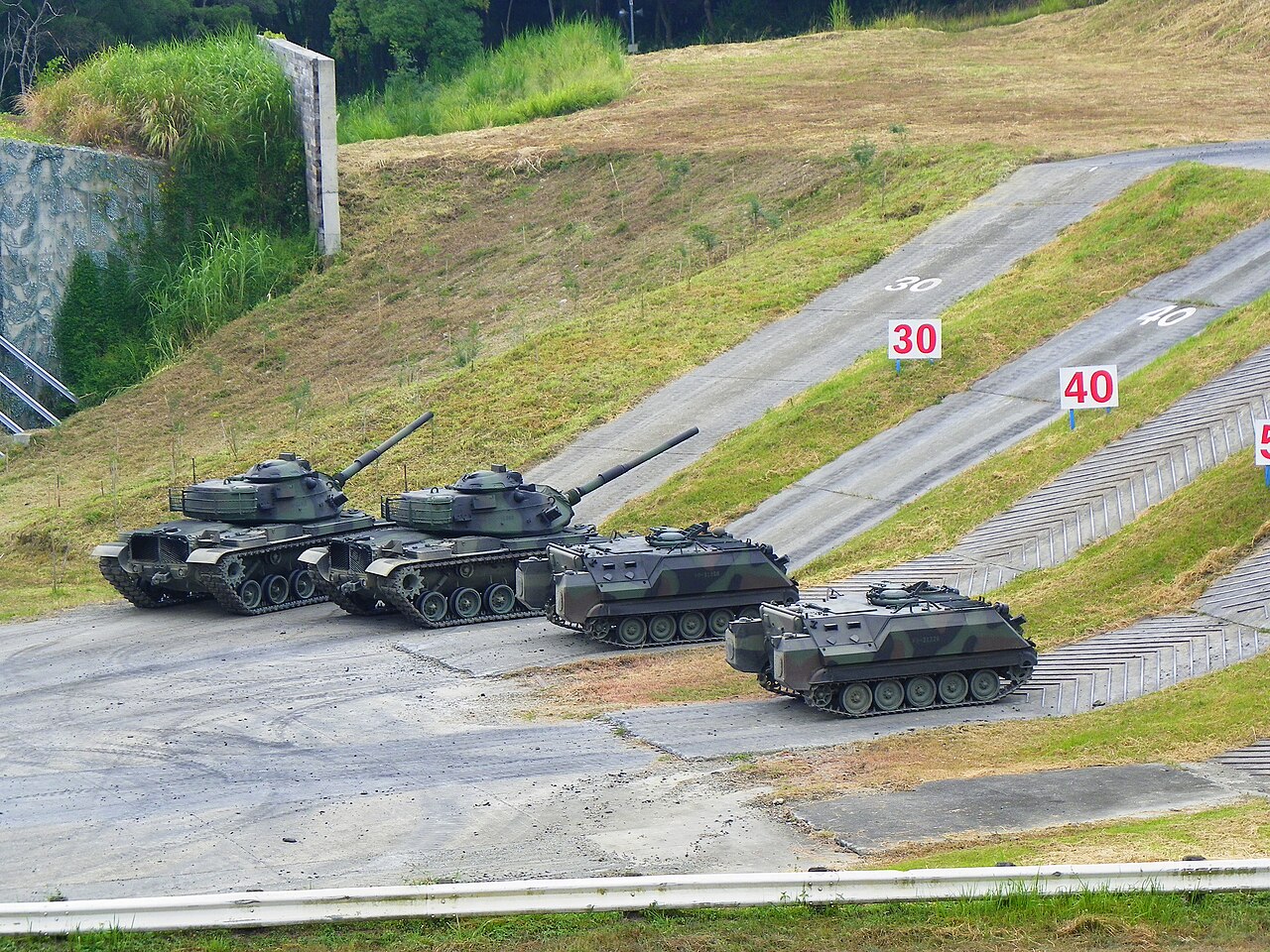
Tanks rolled through Taoyuan streets as 23 Chinese warplanes shadowed the coast. The five-day Immediate Combat Readiness Exercise launched June 22 brought armored vehicles to positions near Taiwan's busiest international airport while China moved its newest aircraft carrier through the strait. Beijing's daily military pressure demands more than show force. It requires a democratic society to adapt to an authoritarian neighbor's campaign to absorb a nation that manufactures 60 percent of the world's semiconductors.
The drills test how quickly Taiwan can shift from peacetime operations to full combat readiness. Defense Minister Wellington Koo warned before the legislature June 24 that warning times for a Chinese attack keep shrinking. The military scrapped scripted exercises in favor of real-time, live-fire training as Chinese forces sent 23 aircraft, seven navy ships, and five government vessels toward the island simultaneously.
"The drills put greater emphasis on the ability to respond quickly and rapidly shift into combat readiness," Koo testified.
Taiwan's defense posture intensified June 10 when the military fired U.S.-supplied HIMARS rockets toward the Chinese coast for the first time. The historic live-fire exercise in Taichung signaled Taiwan's refusal to bend to Beijing's pressure. President Lai Ching-te framed the buildup as self-preservation, not provocation.
"Taiwan's efforts to safeguard its national security, uphold its democratic and free way of life, and reject unification and the rule of the Chinese Communist Party should not be seen as a provocation against China," Lai stated June 18.
The stakes extend far beyond regional tensions. Taiwan manufactures over 60 percent of the world's semiconductors and more than 90 percent of the most advanced chips. A Chinese invasion would paralyze global technology supply chains. The Taiwan Strait also channels one-fifth of all maritime trade, forming a critical link in the strategic first island chain.
Western democracies recognize the necessity of backing Taiwan's sovereignty. The United Kingdom, Germany, and France released a joint statement June 24 condemning Chinese military activity east of Taiwan. Their coordinated response validates the island's self-defense measures and signals that authoritarian expansionism threatens broader regional stability. China's Taiwan Affairs Office responded through spokesperson Zhang Han, who stated Beijing "would not rule out using force" against the island.
American support remains essential to deterring Chinese aggression, though experts note shifting approaches between administrations. Former State Department official Edgard Kagan, now Freeman Chair in China Studies at CSIS, observed that "The president understands leverage" and has "a very, very acute sense of how to use it." This transactional posture contrasts with the Biden administration's diplomatic caution, which some analysts argue emboldened Chinese coercion.
Taiwan currently spends approximately 2.4 percent of GDP on defense. President Lai aims to raise that figure to 3.3 percent this year and 5 percent by 2030. Opposition parties in Taiwan's legislature cut Lai's proposed $40 billion special defense budget by one-third to $25 billion in May. The United States approved a record $11 billion arms package to Taiwan in December 2025, with a $14 billion package now under review.
China's hybrid warfare tactics extend beyond military posturing. Research vessel Xiang Yang Hong 22 conducted marine surveys east of Taiwan under coast guard escort June 16-18. Chinese coast guard ships had begun patrolling east of Taiwan on June 1, though the initial operation ended around June 10 after Taiwan expelled the vessels.
Taiwan National Security Institute deputy secretary-general Ho Cheng-hui warned June 20 that Beijing's gray-zone coercion represents an escalating campaign to normalize Chinese presence and test Western response thresholds before potential conflict.
As Taiwan prepares for larger-scale Han Kuang exercises in August and Joint Defense Exercises in July, the message from Taoyuan's streets remains clear. A free society will fight for its sovereignty against authoritarian expansionism. The world must back that resolve with unwavering support. Taiwan's semiconductor production and position along vital trade routes make its defense essential for global economic stability and the broader Indo-Pacific balance of power.