Carney's Recession Exposes Canada's Per-Capita Collapse
Canada's economy contracted for a second straight quarter, plunging into technical recession and exposing a decade-long collapse in living standards masked by immigration and government spending.
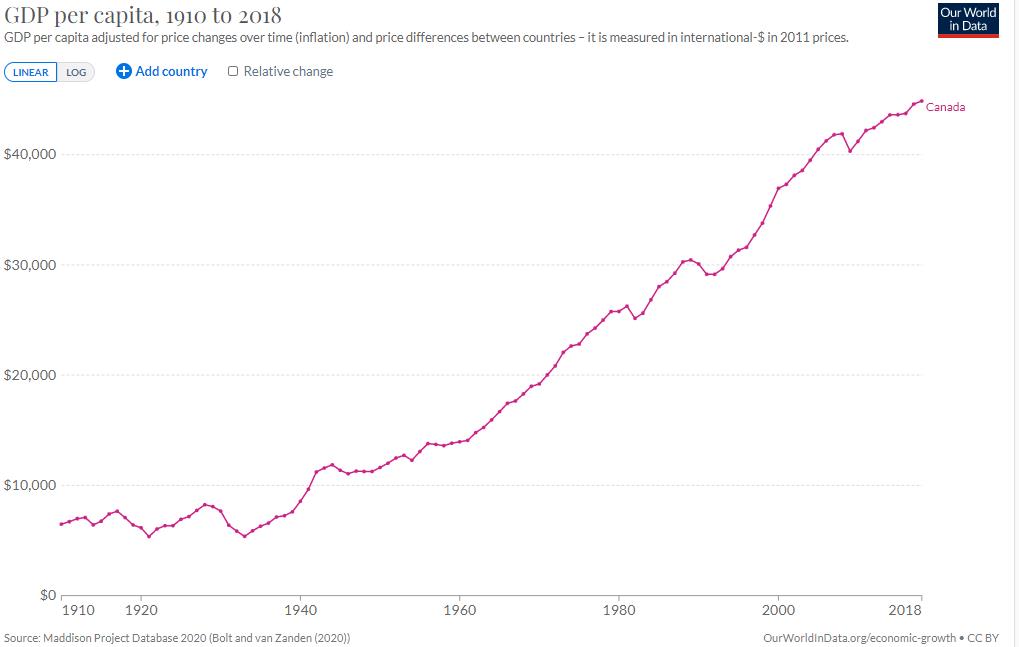
Canadians who once took their standard of living for granted now face an economy in retreat. Canada's gross domestic product contracted for a second consecutive quarter, sliding into technical recession and confirming the failure of Prime Minister Mark Carney's big-spending economic model. Statistics Canada reported May 29 that real GDP shrank 0.1 percent on an annualized basis in the first quarter of 2026, following a downwardly revised 1.0 percent contraction in the fourth quarter of 2025. This two-quarter decline marks Canada's first technical recession since the pandemic's onset in 2020 and directly contradicts the Bank of Canada's 1.5 percent growth forecast.
The surprise contraction exposes a decade-long collapse in living standards that massive immigration and unsustainable government expansion had concealed. "Our economy over the last five years has been driven by government spending that grew over nine percent year-after-year after year, twice the rate of growth of our economy," Carney himself admitted before becoming prime minister. Business capital investment has now fallen for five consecutive quarters, suffocated by a state that absorbs resources at double the economy's growth rate.
The headline GDP figures mask a far starker per-capita reality. Canada's real GDP per capita, measured by purchasing power parity, grew just 3.2 percent from 2014 to 2024, an anemic 0.4 percent annually. The United States surged 20.2 percent over the same period, creating a 40 percent prosperity gap that leaves the typical Canadian with $51,682 compared to the American's $72,375. The Information Technology and Innovation Foundation's "Comfortable Decline" report, published May 25, states that "Canada suffers from three major limitations: no strong political coalition for a dynamic, industrial capitalism supported by techno-industrial policy."
Massive immigration levels had artificially propped up headline GDP while hiding this per-capita decline. Canada's population grew at 1.5 percent annually from 2015 to 2025, more than double the developed world average, flooding the labor market with abundant workers and discouraging capital investment. That demographic-driven growth model has now reached its breaking point. Canada's population declined by approximately 102,000 people in 2025, marking the first annual population decline in the nation's history since 1867.
Conservative Leader Pierre Poilievre demanded an emergency parliamentary debate, calling for legislation to reverse the policies he blames for the downturn. "The only way out of this Liberal recession is to reverse the policies that caused it in the first place," Poilievre stated May 29. "Mark Carney is now the only leader in the G7 to have plunged his economy into recession. He's been prime minister for four quarters now. The economy has shrunk in three of those quarters."
Institutional analysis confirms Canada faces a long-term structural crisis. The Organization for Economic Cooperation and Development projects Canada will rank dead last among all 38 OECD members in real GDP per capita growth through 2060. The ITIF report notes Canada has fallen from eighth to 17th in the World Intellectual Property Organization's Global Innovation Index since 2011, with Canadian firms investing just $9.3 billion in research and development in 2024 compared to $746 billion in the United States.
Household savings have plummeted to a 3.5 percent rate, the lowest since early 2024, while the Canadian dollar fell to C$1.3822 per U.S. dollar immediately following the GDP announcement. Both consumers and markets have lost confidence in the government's economic stewardship. The household saving rate drop to 3.5 percent in the first quarter signals families have exhausted their financial cushions, with food inflation running at 3.8 percent and grocery prices rising nearly 30 percent over five years.
Finance Minister François-Philippe Champagne defended the government's record in Question Period, citing "generational investment in housing, in infrastructure, in productivity and innovation." Business investment tells a different story. Capital expenditures fell 0.7 percent in the first quarter, the fifth consecutive quarterly decline, while government capital investment fell 2.5 percent in the first quarter, following notable strength throughout most of 2025.
The economic contraction occurred despite a 2.9 percent surge in imports, largely driven by gold purchases, and a 1.5 percent increase in household spending. Final domestic demand fell 0.4 percent annualized. "Many small business owners have put investments on hold due to uncertainty in the economy and rising costs from things like energy," said Dan Kelly, president of the Canadian Federation of Independent Business.
Canada's per-capita GDP crisis has been building for a decade. The country ranked 19th of 38 OECD nations in GDP per capita purchasing power parity in 2024, down from 17th in 2014, and fell below the OECD average for the first time in recorded history at 99.5 percent of the group's mean. The productive capital stock declined 8 percent as a share of GDP between 2013 and 2023, with industrial machinery dropping 19 percent and computer and electronics equipment falling 10 percent.
The immigration surge exacerbated the productivity challenge by shifting labor composition toward temporary, lower-skilled workers who crowd out high-skilled immigrants that drive innovation. "The sheer volume increased population growth, making labor abundant and encouraging the substitution away from capital," notes The Hub's deep dive on Canada's GDP per capita crisis, published March 20. Canadian workers received only 55 cents of new capital for every dollar received by U.S. workers in 2025.
Three of Canada's last four quarters have posted negative real GDP growth, with the country shedding more than 100,000 jobs in January and February alone. Unemployment stands at roughly 6.7 to 6.9 percent, the second-highest in the G7 behind France. The Bank of Canada has held its policy rate at 2.25 percent for four consecutive meetings, with markets assigning 99 percent odds against a rate hike at the June 10 decision.
What Statistics Canada labels a technical recession represents the visible symptom of a deeper disease. Government spending grew at twice the economy's rate while crushing the private investment needed for genuine prosperity. As the population growth that masked this decline reverses for the first time in history, Canadians now face the reality of being 40 percent poorer than their American neighbors, with no clear path to recovery under current policies.