Trump Donors Choose Rubio Over Vance for 2028 Succession
At a private Mar-a-Lago gathering, roughly 25 top GOP donors told Trump they want Marco Rubio — not JD Vance — as his 2028 successor, igniting a quiet donor-driven draft movement.
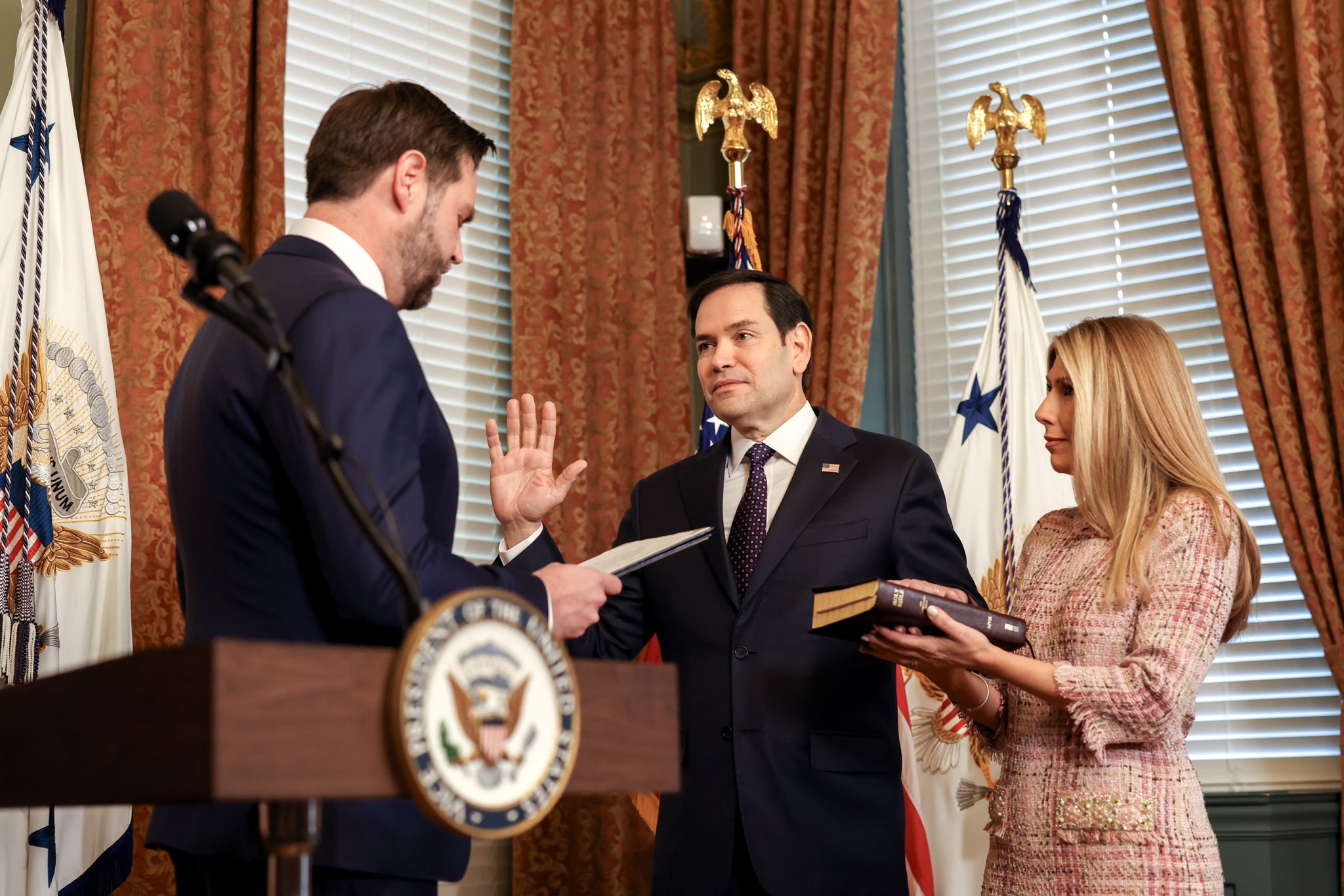
President Donald Trump put a pointed question to roughly 25 of the Republican Party's most influential donors at Mar-a-Lago on Feb. 28: Marco Rubio or JD Vance for 2028? The room barely hesitated.
Attendees described the response as "almost unanimous for Marco." One donor put a finer number on it: "80-20 Marco." Among those present were New England Patriots owner Robert Kraft and billionaire Georgia gubernatorial candidate Rick Jackson — the kind of checkbook power that shapes presidential campaigns long before a single vote is cast.
The private exchange has since ignited a quiet movement. A network of Republican contributors has begun mapping ways to elevate Rubio ahead of the 2028 election, according to ABC News. The effort is being driven by donors and surrogates, not Rubio himself — a distinction that underscores how organically his standing has grown inside the administration.
That standing rests on a formidable portfolio. Rubio serves simultaneously as Secretary of State, Acting National Security Adviser and Acting Director of the U.S. Agency for International Development. He led the Venezuela operation that removed Nicolás Maduro in January. When U.S.-Israeli airstrikes struck Iran in late February, Rubio stood beside Trump in a makeshift Mar-a-Lago situation room while Vance remained in Washington.
Trump has taken notice — loudly. During his State of the Union address, the president declared Rubio had done "a great job" and predicted he "will go down as the best (Secretary of State) ever." Trump has also privately circulated word of how popular Rubio has become within the inner circle.
The donor class is clearly listening. Public polling, however, tells a sharply different story. An Emerson College survey from late February showed Vance commanding 52 percent among likely Republican primary voters against Rubio's 20 percent. A J.L Partners poll found the gap wider still: Vance at 53 percent, Rubio at 14 percent.
Prediction markets, though, are moving. On Kalshi, Rubio's odds of winning the presidency reached 18 percent on March 12, nearly matching Vance's 19 percent — a surge from just 6 percent in December. On Polymarket, Rubio sits at 26 percent against Vance's 38.5 percent. The gap is narrowing faster than the polls suggest.
Behind the numbers, infrastructure may already be taking shape. America 2100, a 501(c)4 political nonprofit founded in 2023 by Rubio's former chief of staff Mike Needham, has banked just under $3 million according to its latest IRS filing. The organization's slogan echoes Rubio's 2016 campaign motto; it circulated videos backing the Trump-Vance ticket in fall 2024 but has remained dormant since — a coiled spring waiting for a signal.
Republican strategist and former Rubio campaign adviser Buzz Jacobs frames the moment plainly. "Marco has been doing an amazing job as secretary of state and national security adviser and others, and, as a result, he has earned a lot of respect within the party, from all parts of it, from the MAGA base to the neocon establishment. He has proven himself. And, as a result, that has many people talking about him becoming the presidential nominee of the party instead of the vice president," Jacobs said.
Not everyone is impressed by the donor enthusiasm. "Donors don't pick the nominee — the base picks," a senior Republican operative told ABC News. "Donors tried to abandon President Trump and tried to pick Florida Gov. Ron DeSantis, and we all saw how that went." It is a warning the Rubio camp cannot afford to dismiss.
Vance retains formidable structural advantages. He serves as finance chair of the Republican National Committee and commands the loyalty of the Rockbridge Network, a coalition of wealthy GOP donors and party operatives. Turning Point USA has endorsed him, and major tech figures including Peter Thiel and Elon Musk back his political future.
A former Trump administration official draws a clean line between the two camps. "The Mar-a-Lago donor crew are not JD people," the official said. "He did not get picked to be vice president because of the Mar-a-Lago crowd. If you remember, that crowd was lobbying the president to pick Marco. If there were a poll taken tomorrow, I'd bet JD is still up by 40 points."
Yet some observers argue Vance carries a different kind of liability. "Months ago, I called it the Tucker dilemma," said influential far-right activist Laura Loomer. "I said that JD Vance has a Tucker problem. I believe that one of the reasons why a lot of the GOP donors, as well as a lot of the GOP base, is souring on JD is that he has not explicitly condemned Tucker. If he doesn't disavow him, Marco's going to be the nominee." It is the kind of intraparty pressure that can quietly erode a frontrunner's support.
Vance's camp has pushed back on other fronts. His spokesperson denied reports suggesting the vice president was skeptical of the Iran strikes. White House communications director Steven Cheung dismissed the broader media narrative outright: "The President has assembled an all-star team that has achieved unprecedented success in just over one year. No amount of crazed media speculation about Vice President Vance and Secretary Rubio will deter this Administration's mission of fighting for the American people."
Rubio himself has publicly pledged loyalty to his boss's deputy. "If J.D. Vance runs for president, he's going to be our nominee, and I'll be one of the first people to support him," Rubio told Vanity Fair in 2025, a commitment he reiterated to Politico in November. A third source close to the White House describes the working expectation as Vance atop the ticket with Rubio as his running mate. Yet sources suggest Rubio has not ruled himself out if circumstances shift.
Trump has said he would like to see both men run together, without specifying who belongs at the top. That single unresolved question — whose name leads the ticket — may ultimately define the Republican Party's next chapter.