Iran Mines Strait as FM Heads to Pakistan Amid U.S. Carrier Buildup
As Iran's foreign minister arrives in Pakistan for diplomatic talks, the IRGC lays new mines in the Strait of Hormuz while the U.S. positions three aircraft carriers in an unprecedented show of force.
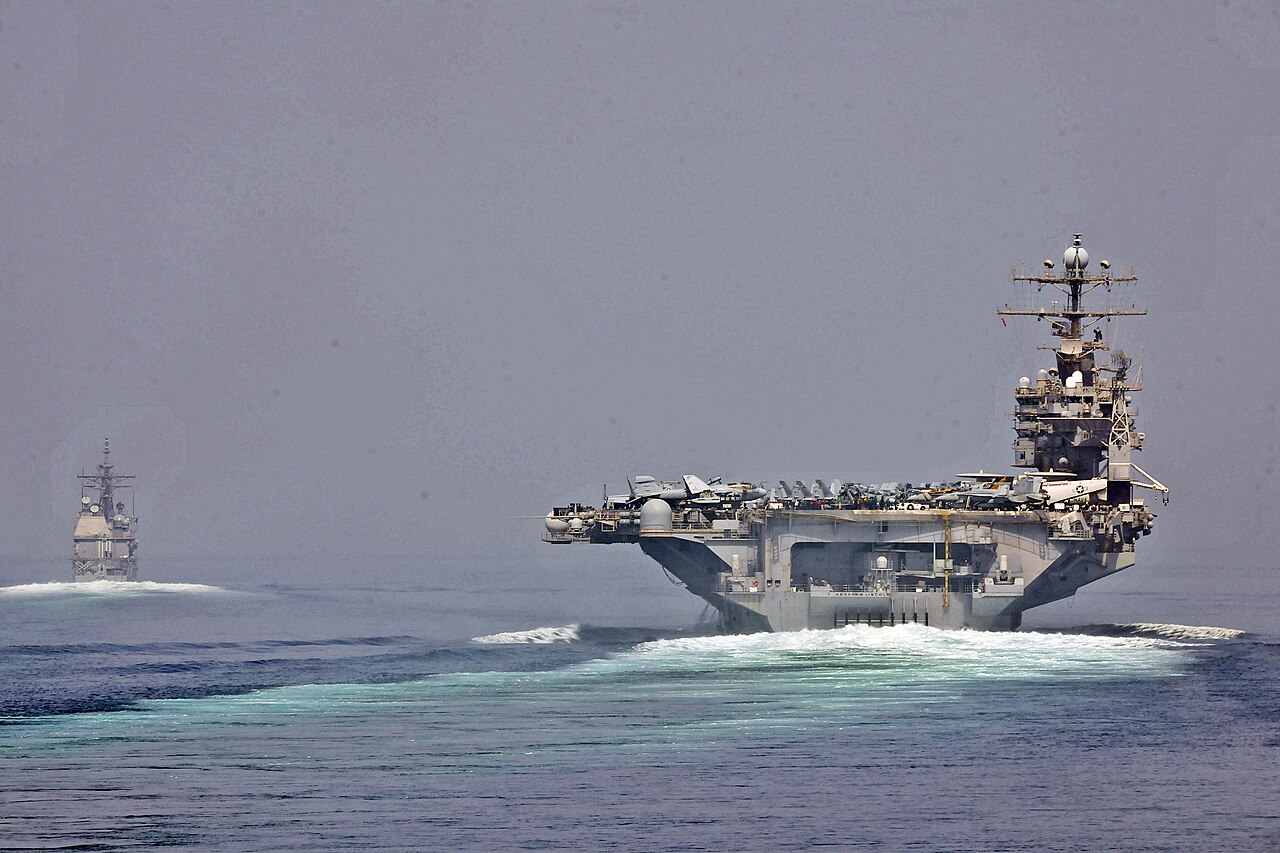
As Iran's foreign minister prepared to land in Islamabad Friday night for potential breakthrough talks with Washington, the Islamic Revolutionary Guard Corps quietly laid more sea mines in the Strait of Hormuz. The contradiction exposes a regime tearing itself apart — IRGC hawks refuse to compromise while a civilian leadership, desperate for economic relief, watches its country lose $435 million every day.
Axios reported Friday that IRGC forces deployed additional mines in the Strait of Hormuz this week, even as Foreign Minister Abbas Araghchi headed to Pakistan's capital for diplomatic engagement. The contradiction exposes the Islamic Republic's internal split between IRGC intransigence and a civilian leadership caught in economic strangulation. Meanwhile, the U.S. deployed three aircraft carriers to the region for the first time since the 2003 Iraq invasion, signaling that President Trump's patience is finite and military escalation remains on the table.
"I have ordered the United States Navy to shoot and kill any boat, small boats though they may be, that is putting mines in the waters of the Strait of Hormuz," Trump declared on Truth Social Thursday. "There is to be no hesitation." Pentagon officials told Congress earlier this week that Iran placed at least 20 mines in the Strait.
Defense Secretary Pete Hegseth drove home the ultimatum Friday at a Pentagon briefing. "Any attempts to lay mines by Iran is violation of ceasefire," he stated. "All they have to do is abandon a nuclear weapon in meaningful and verifiable ways, or instead they can watch the regime's fragile economic state collapse under the unrelenting pressure of American power."
The three-carrier deployment represents a historic show of force. USS Abraham Lincoln, USS Gerald R. Ford, and USS George H.W. Bush now operate simultaneously in the CENTCOM area, the first such concentration since the Iraq invasion. Together they field more than 200 aircraft and 15,000 personnel, a force posture designed for comprehensive operations beyond targeted strikes.
Diplomatic channels remained open even as warships closed in. Araghchi held separate calls Friday with Pakistan's Deputy Prime Minister Ishaq Dar and Army Chief Asim Munir. Pakistan's government confirmed a "high likelihood of breakthrough" as Araghchi prepares for potential negotiations with Washington. Yet Al Jazeera reported no direct Iran-U.S. talks will occur during this visit, only bilateral engagement with Pakistan.
Speculation mounted that Parliament Speaker Mohammad Bagher Ghalibaf, who led the first round of talks, has been replaced by Araghchi for round two. Iran International reported Ghalibaf was reprimanded for discussing nuclear issues and forced to step down. Araghchi previously called the IRGC's restriction on raising nuclear matters a "death sentence" for negotiations, making the delegation's presence "basically useless."
The IRGC's increasing control over Iranian state functions complicates any diplomatic progress. The military bloc has blocked President Masoud Pezeshkian from appointing a new intelligence minister and installed a "military council" of senior IRGC officers controlling access to Supreme Leader Mojtaba Khamenei. Analysts note this power consolidation makes civilian-led negotiations potentially hollow.
"This has been the process in Iran for years now, as the regime has chosen conflict over cooperation and emboldened its security forces at every juncture," said Behnam Ben Taleblu of the Foundation for Defense of Democracies. Lisa Daftari, a foreign policy analyst, added, "By any standard, Vahidi is considered a radical even within the regime's hardline elite, and his rise is a warning that Tehran's war machine now calls the shots."
Economic pressure on Iran mounts by the hour. Brent crude trades at approximately $104 per barrel, nearly 50 percent above pre-war levels. Iran's daily economic losses are estimated at $435 million, and the country's oil storage may run out in two to three weeks, according to former Treasury sanctions expert Miad Maleki. The U.S. naval blockade has turned around 34 Iran-linked ships since April 13.
"I have all the time in the World, but Iran doesn't — The clock is ticking!" Trump posted Thursday. He dismissed suggestions of nuclear weapon use against Iran, telling Fox News, "No. Why would a stupid question like that be asked? Why would I use a nuclear weapon, when we've totally, in a very conventional way, decimated them without it."
The U.S. Navy faces significant mine-clearing challenges after decommissioning its last four Avenger-class mine countermeasure ships in September 2025 and phasing out MH-53E Sea Dragon helicopters last August. Only USS Canberra, a littoral combat ship, is confirmed as a dedicated mine countermeasure asset in the region. Pentagon spokesperson Sean Parnell denied a leaked six-month mine-clearing estimate as "cherry picking" and an "impossibility."
Iran's reckless mine deployment compounds the danger. Just Security documented that Iran cannot locate all mines it laid, a haphazard, decentralized operation without systematic tracking. The IRGC's declared "danger zone" covers 1,400 square kilometers, 14 times the size of Paris, using an estimated stockpile of 2,000 to 6,000 mines.
The next 48 hours will determine whether Araghchi's diplomatic overture results in a genuine deal or whether the IRGC's mine-laying and refusal to compromise on nuclear issues pushes the U.S. toward renewed military escalation. With three carriers positioned and Trump's shoot-to-kill order in effect, the U.S. demonstrates readiness for comprehensive operations, not just targeted strikes. Iran now faces its starkest choice yet: negotiate under maximum pressure or watch its economy collapse while military forces prepare for a decisive confrontation. Families across Tehran already feel the strain — shelves empty, savings evaporate, and the weight of regime brinkmanship settles on ordinary lives.