Russia Fires Hypersonic Missile on Kyiv as European Defense Gap Widens
Russia deployed a Mach-10 Oreshnik hypersonic missile in a massive overnight attack on Kyiv, exposing critical vulnerabilities in European air defense capacity and raising urgent questions about Western deterrence.
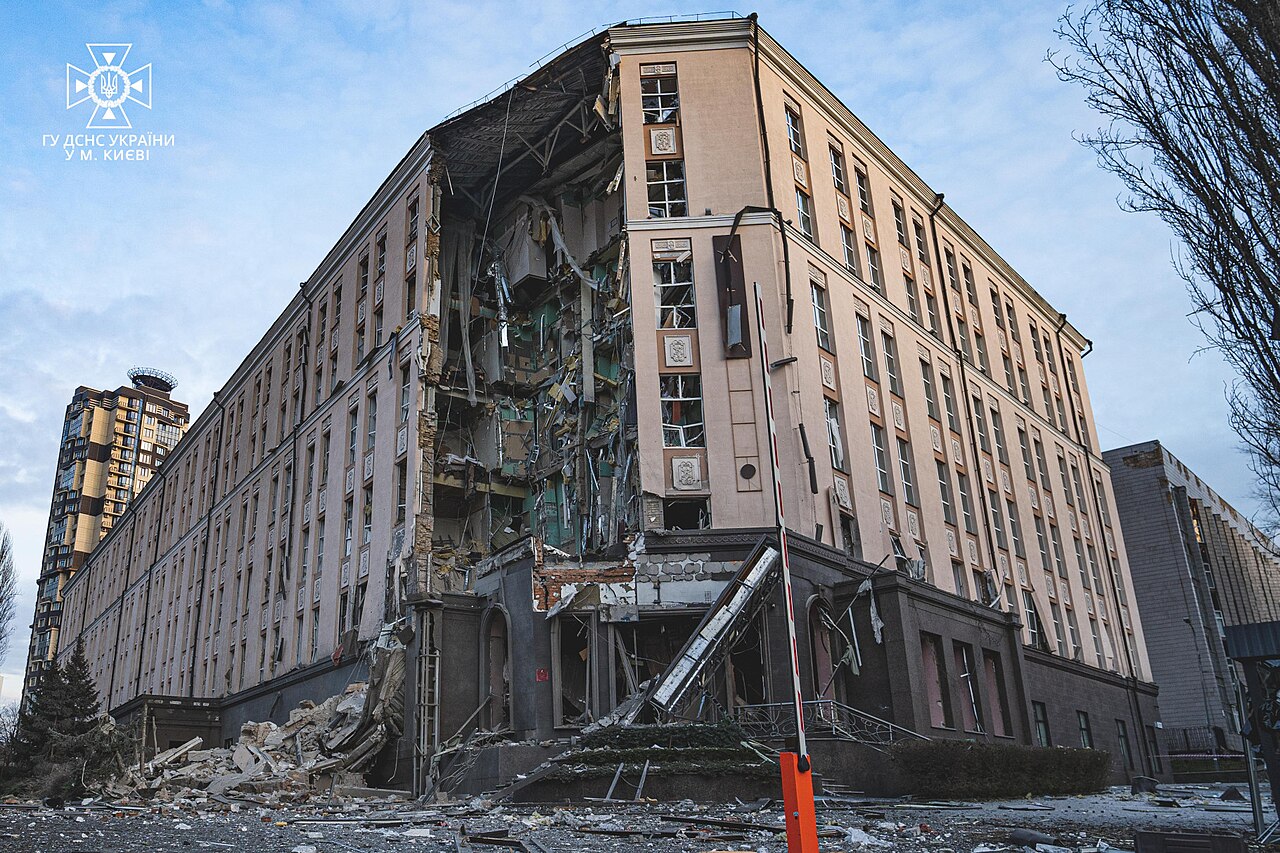
Smoke still rose over Kyiv's government district Monday morning as residents picked through the wreckage of a school hit while children sheltered inside. The overnight barrage of 90 missiles and 600 drones, capped by Russia's deployment of a Mach-10 Oreshnik hypersonic ballistic missile, exposed a fatal gap between European defense ambitions and military reality. Diplomatic patience has only emboldened Vladimir Putin to escalate while leaving NATO's eastern flank dangerously vulnerable.
Yevhen Zosin, 74, described being "thrown back like a pin by the shock wave" when a residential building collapsed in Shevchenko district. The assault damaged government offices, museums, schools and markets across every district of the capital. Ukrainian air defenses intercepted 549 drones and 55 missiles but could not stop 19. Kyiv Mayor Vitali Klitschko called it "a terrible night for Kyiv" as rescuers cleared debris and medics treated victims.
Russia's overnight attack demonstrates production capacity that Europe's fragmented defense industry cannot match. The Oreshnik's third use in 18 months signals a deliberate escalation strategy targeting civilian infrastructure to break Ukrainian morale. "They really are unhinged," Ukrainian President Volodymyr Zelenskyy told reporters. "It's vital that this doesn't go unpunished for Russia."
The nuclear-capable Oreshnik travels at Mach 10 with a 3,000 to 5,500 kilometer range, classified as an intermediate-range ballistic missile. Ukrainian Foreign Minister Andrii Sybiha stated the missile carried a dummy warhead. EU foreign policy chief Kaja Kallas called Moscow's use "reckless nuclear-brinkmanship" designed to test Western red lines. Russia's Defense Ministry confirmed deploying Oreshnik alongside Iskander, Kinzhal and Zircon missiles in retaliation for strikes on Russian territory.
Europe faces a looming mathematical crisis in air defense capacity. Russia produces up to 30,000 Geran-2 drones and 2,000 cruise missiles annually, according to CSIS analysis. Europe manufactures only 220 to 250 Aster 30 interceptors and 800 to 1,000 IRIS-T missiles each year. This production disparity means Europe cannot defend itself against sustained Russian campaigns without relying on dwindling U.S. stockpiles.
Ukraine's reliance on Patriot interceptors on a "starvation ration" highlights Western strategic vulnerability. The PURL program delivered approximately 75 percent of Patriot interceptors to Ukraine by late 2025, and American stocks are stretched by other global conflicts. Even advanced systems face saturation when interceptors are scarce, making European defense dependence a critical weakness.
"Russia hit a dead-end on the battlefield, so it terrorizes Ukraine with deliberate strikes on city centers," said EU foreign policy chief Kaja Kallas. European Commission President Ursula von der Leyen condemned the attack as "despair" and announced additional air defense support. German Chancellor Friedrich Merz called the Oreshnik use a "reckless escalation." French President Emmanuel Macron condemned it as an "escalation" in "Russia's war of aggression."
Despite rhetorical commitments, European defense funding falls short of what analysts estimate is needed. A proposed "ASAP for Air Defense" program would require 5 to 10 billion euros to boost interceptor production. "I believe Europe should be able to produce everything it needs to defend against everything — all the ballistic attacks and all other weapons — on its own," Zelenskyy told fellow leaders during a summit of the European Political Community in Armenia.
The attack followed warnings from U.S. and European intelligence about potential Oreshnik deployment. Russia claimed retaliation for Ukrainian strikes on a student dormitory in Starobilsk that killed 18 people, though Ukraine said it targeted a military drone unit. Zelenskyy now demands international punishment. "Decisions are needed — from the United States, from Europe and others," he said.
Poland scrambled fighter jets and closed airspace near southeastern cities in response. Albania's foreign minister reported the Albanian ambassador's residence in Kyiv was hit, calling it "unacceptable" escalation. Damage included the Chernobyl Museum, one of Kyiv's oldest markets, and the Foreign Ministry building for the first time since World War II.
European production cannot mathematically counter Russia's offensive output, rendering bureaucratic approaches obsolete. Only robust, independently funded defense industrial capacity can deter authoritarian aggression. As smoke clears over Kyiv, the strategic imperative remains clear: decisive Western military support and European defense independence are essential to prevent further Russian escalation.