Pentagon Infighting Forces Phelan Out Amid Shipbuilding Clash
Navy Secretary John Phelan departs after 13 months as clashes over Trump's battleship program and Pentagon bureaucracy expose deep institutional resistance to the administration's military modernization agenda.
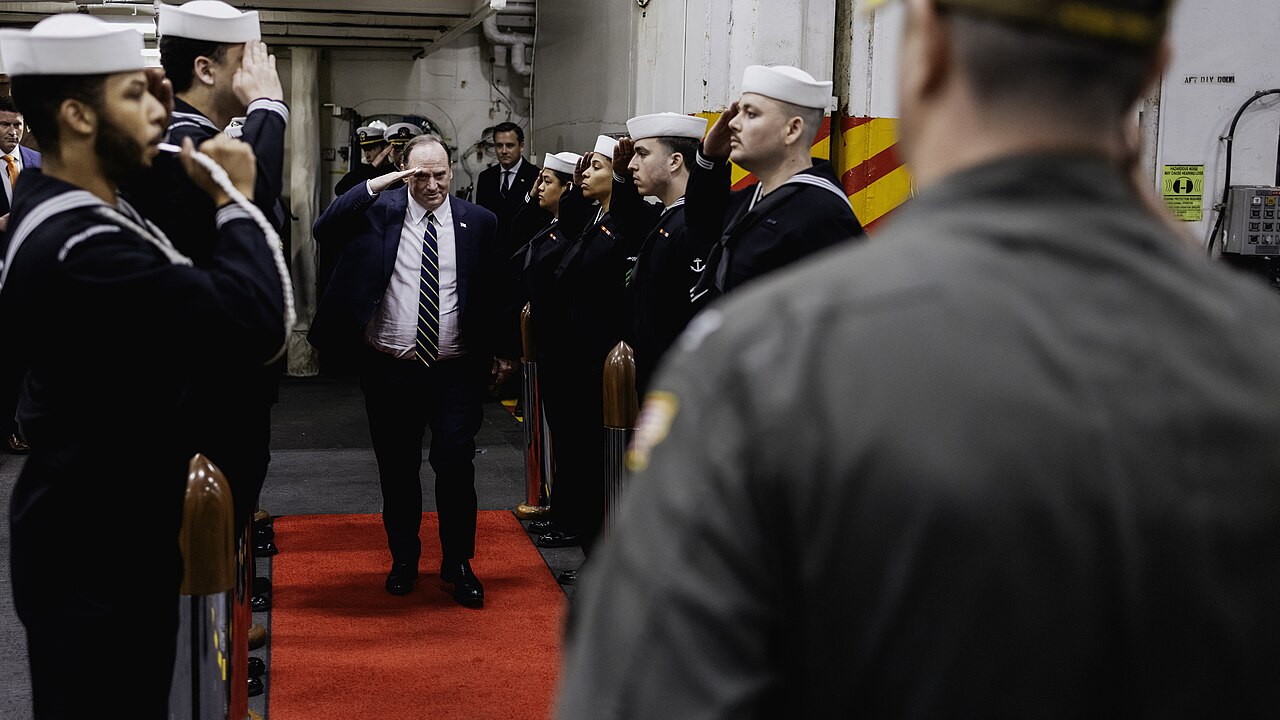
Navy Secretary John Phelan walked out of the Trump administration on April 22, just 13 months into a tenure defined by battleship ambitions and bureaucratic resistance. His departure arrives as American warships enforce a naval blockade of Iranian ports, a timing that has lawmakers and defense experts questioning what leadership instability means for operations underway.
Trump later called it a resignation driven by "internal conflicts." The reality, according to multiple sources, points to a forced exit after Pentagon leadership grew frustrated with Phelan's shipbuilding approach.
Pentagon spokesman Sean Parnell announced on X that Phelan was "departing the administration, effective immediately" and thanked him for his service. Navy Undersecretary Hung Cao, a 32-year veteran, stepped in as acting secretary.
The flashpoint was Trump's battleship program. The president announced the USS Defiant BBG-1, the lead ship of the "Trump class," on Dec. 22 as the centerpiece of his "Golden Fleet" initiative. Trump called for the first vessel by 2036, with an estimated price tag of $17.47 billion.
Phelan embraced the vision. Secretary of War Pete Hegseth and Deputy Secretary Stephen Feinberg did not.
Hegseth and Feinberg favored a pivot toward smaller, cheaper uncrewed vessels. Feinberg moved to centralize oversight of major shipbuilding programs, stripping Phelan of authority over key efforts. The maneuver left Phelan fighting a losing battle inside his own department.
"This project will be managed by NAVSEA, an organization and staff that has screwed up every surface warship program of this century," said Carl Schuster, a former Navy captain and defense analyst.
The battleship dispute exposed something larger: a Pentagon establishment that has resisted Trump's military priorities since his return to office. Phelan, a wealthy businessman who donated $834,600 to Trump's 2024 campaign, lacked military experience but matched Trump's ambition. He bypassed Hegseth to take issues directly to the president, a habit that created friction with Pentagon leadership.
Hegseth has removed or forced out at least 13 senior military leaders since early 2025, including Gen. Charles Q. Brown Jr., Adm. Lisa Franchetti and Gen. Randy George. Phelan's exit marks the first service secretary to leave under Trump. The systematic clearing of establishment figures represents a concerted effort to reshape a military hierarchy.
Trump tried to frame the departure as voluntary. He told reporters April 23 that Phelan "had some conflict with, not necessarily Pete, with some other" Pentagon officials over shipbuilding. On Truth Social, he wrote that Phelan "decided to move on" and that he would "certainly like to have him back within the Trump Administration sometime in the future."
Multiple sources contradicted that account. A senior administration official told Fox News that "Trump and Hegseth agreed new leadership at the Navy is needed." Two sources told CNN that Hegseth informed Phelan he needed to resign or be fired via message before the X announcement went live. CNN reported six sources were familiar with the ouster, and at least two White House staffers told Phelan it was Trump's decision. Phelan did not wait to see the X post. Hegseth told him first.
The timing of the departure raised operational concerns. It came nine days into a U.S. naval blockade of Iranian ports in the Strait of Hormuz, a chokepoint handling roughly 20 percent of global oil shipments.
"Secretary Phelan's abrupt dismissal is troubling," said Sen. Jack Reed, the top Democrat on the Senate Armed Services Committee. "I am concerned it is yet another example of the instability and dysfunction that have come to define the Department of Defense under President Trump and Secretary Hegseth."
Sen. Lisa Blunt Rochester added, "When they fire the Chief of Army and the Secretary of the Navy during a war, they know it's going badly."
Hung Cao brings a starkly different profile as acting secretary. The 54-year-old retired captain fled communist Vietnam as a child and spent 25 years as an Explosive Ordnance Disposal officer, with special operations deployments to Iraq, Afghanistan and Somalia.
Upon his appointment, Cao posted on X that his "immediate priorities are taking care of our Sailors and Marines, advancing shipbuilding initiatives, and ensuring the defense of our homeland." He previously drew controversy for opposing drag performers in military recruiting and comparing the Biden administration to Vietnam's communist regime.
The battleship program at the center of the clash faces steep technical and financial hurdles regardless of Pentagon politics. The Congressional Budget Office has provided cost estimates for the lead ship, though precise figures vary depending on timing.
"There is little need for said discussion because this ship will never sail," said Mark F. Cancian of the Center for Strategic and International Studies. "A future administration will cancel the program before the first ship hits the water."
Adm. Daryl Caudle offered support, calling the battleships "badass" and noting they would "afford the service multiple critical capabilities." The Navy's FY27 budget request includes $377 billion total, with $65.8 billion for shipbuilding, up from roughly $42 billion in FY26.
Broader Navy programs continue to struggle. The Columbia-class submarine program, the service's top priority, sits 17 months behind schedule into 2029. The Navy's industrial base faces capacity constraints that Phelan sought to address through partnerships with South Korean and Japanese shipyards, a proposal Hegseth reportedly opposed on "Buy American" grounds.
Phelan's ouster lays bare the fundamental tension between Trump's ambitious military vision and a Pentagon establishment that has resisted his agenda at every turn. The Navy stretches thin across multiple theaters while actively blockading Iranian ports. Sailors and Marines carry out dangerous missions under leadership in flux. When the bureaucracy and the commander in chief cannot agree on what kind of fleet America needs, the people who serve at sea pay the price.