Fire Guts Sleeping Quarters on USS Gerald R. Ford, Leaving 600 Sailors Without Beds
A 30-hour fire tore through the USS Gerald R. Ford's berthing compartments, displacing 600 sailors already stretched by a record-approaching 266-day deployment in the Red Sea.
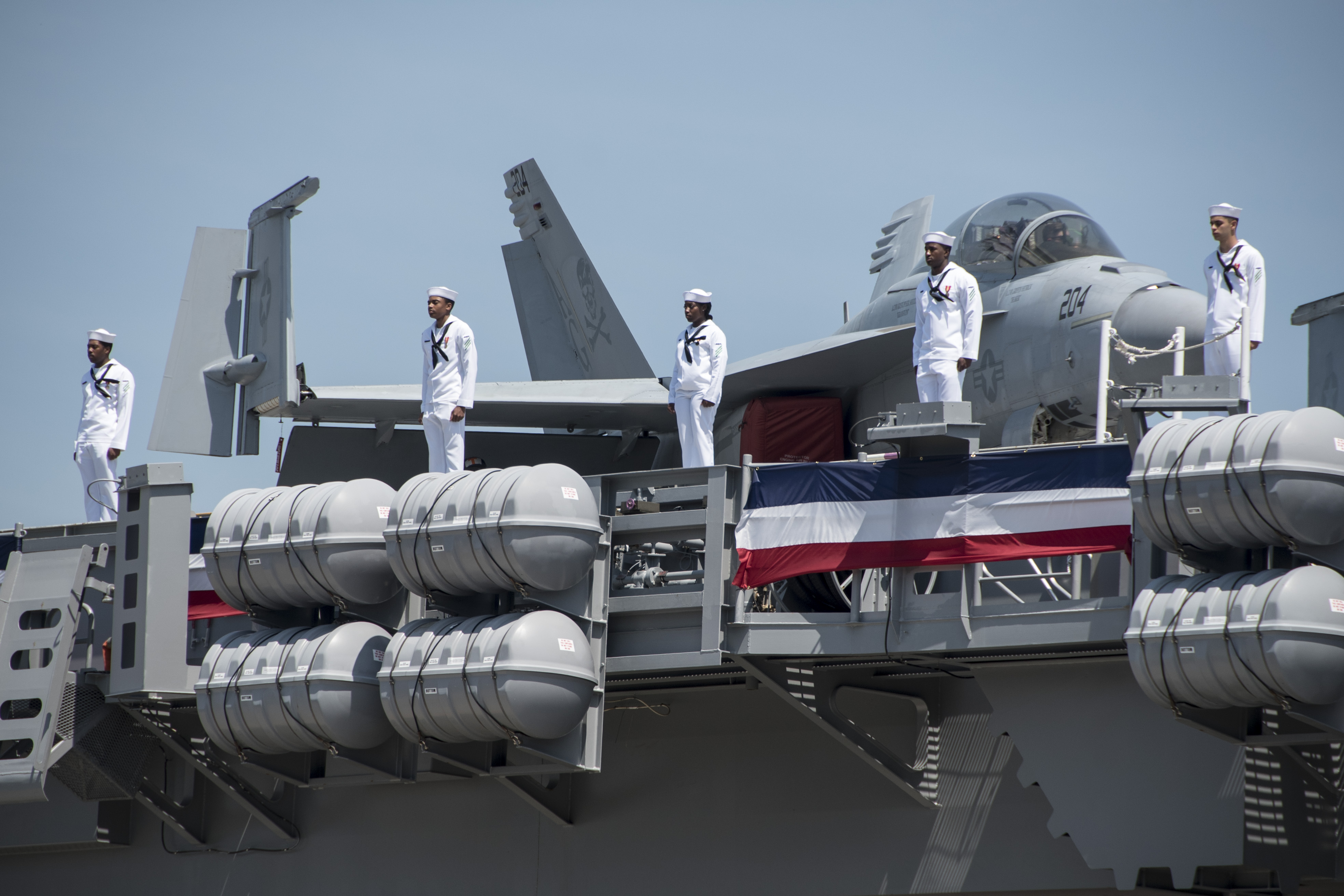
Six hundred sailors lost their beds when flames ripped through the USS Gerald R. Ford for more than 30 hours, forcing crew members to sleep on floors and tables in the middle of an 11-month deployment.
The fire broke out in the ship's main laundry area last Thursday and spread through ventilation ducts into berthing compartments, destroying more than 100 beds and displacing roughly one-eighth of the crew. The Pentagon's March 12 statement had described a contained fire with no operational impact. Sailors on board tell a different story — a harrowing ordeal that left dozens gasping from smoke inhalation.
The aftermath triggered a scramble for basic necessities aboard the Navy's most advanced aircraft carrier. Displaced crew members bunked wherever they could find space while laundry services went dark. The Navy pulled 1,000 mattresses from the USS John F. Kennedy to cover sleeping surfaces, then gathered nearly 2,000 sweatsuits and clothing items for sailors with no way to clean their uniforms.
Three sailors sustained non-life-threatening injuries. Two received treatment and returned to duty; a third was flown off the ship for further medical care. Dozens more were treated for smoke inhalation, according to personnel on board and multiple reports citing military sources.
The fire is the latest blow to a carrier already pushed to its limits. The Ford has been at sea since June 24, 2025 — 266 days and counting — making this deployment one of the longest since the Vietnam War era. Originally bound for European waters, the ship was redirected to the Caribbean for Venezuela operations, then to the Red Sea for ongoing military action in the region.
The crisis compounds a string of pre-existing operational failures that have shadowed the vessel throughout its voyage. Documents obtained through Freedom of Information Act requests show the ship's sewage system has averaged one maintenance call per day.
The Pentagon pointed to crew resolve. "Due to the fire, several berthing spaces and subsequently, more than 100 racks (beds) were lost. An immediate plan to acquire replacement cots has already been established," a Pentagon spokesperson said. "The resiliency and mental grit of our Sailors has enabled USS Gerald R. Ford (CVN-78) to support ongoing operations."
Chief of Naval Operations Adm. Daryl Caudle had already flagged the human cost of deployments stretched beyond their original scope. "I am a big non-fan of extensions," he stated in January. "People want to have some type of certainty that they're going to do a seven-month deployment. When it goes past that, that disrupts lives. It disrupts things like funerals that were planned, marriages that were planned, babies that were planned."
The weight of those words lands harder now. "They are tired," a sailor's parent told NPR. "The fire obviously impacted morale, further degrading it after their last extension."
Military analysts warn that exhaustion compounds risk in ways that go beyond morale. "Ships get tired too, and they get beat up over the course of long deployments," said retired Rear Adm. John F. Kirby, who served as Pentagon press secretary. "You can't run a ship that long and that hard and expect her and her crew to perform at peak capacity."
Retired Navy Capt. John Cordle, a human factors engineer, sharpened that concern. "There's a difference between the can-do attitude and the just-get-it-done attitude," Cordle said, warning that exhausted crews take shortcuts.
The Ford is now headed to Souda Bay, Crete, for pierside repairs. The Navy's investigation into the fire's cause remains open, with no official confirmation of whether sabotage is under consideration. Vice Chief of Naval Operations Adm. James Kilby has acknowledged the extended deployment is already delaying the ship's maintenance schedule, with downstream consequences for future readiness.
No official timeline for relief exists. For the 600 sailors who lost their beds — and the families counting the days at home — the question is no longer how much more the ship can take. It's how much more the crew can.