Sanctions Force Socialist Venezuela to Purge Military Leadership
Three months after U.S. forces captured Nicolás Maduro, acting President Delcy Rodríguez has overhauled Venezuela's military, opened its oil sector, and won sanctions relief — a transformation diplomacy never achieved.
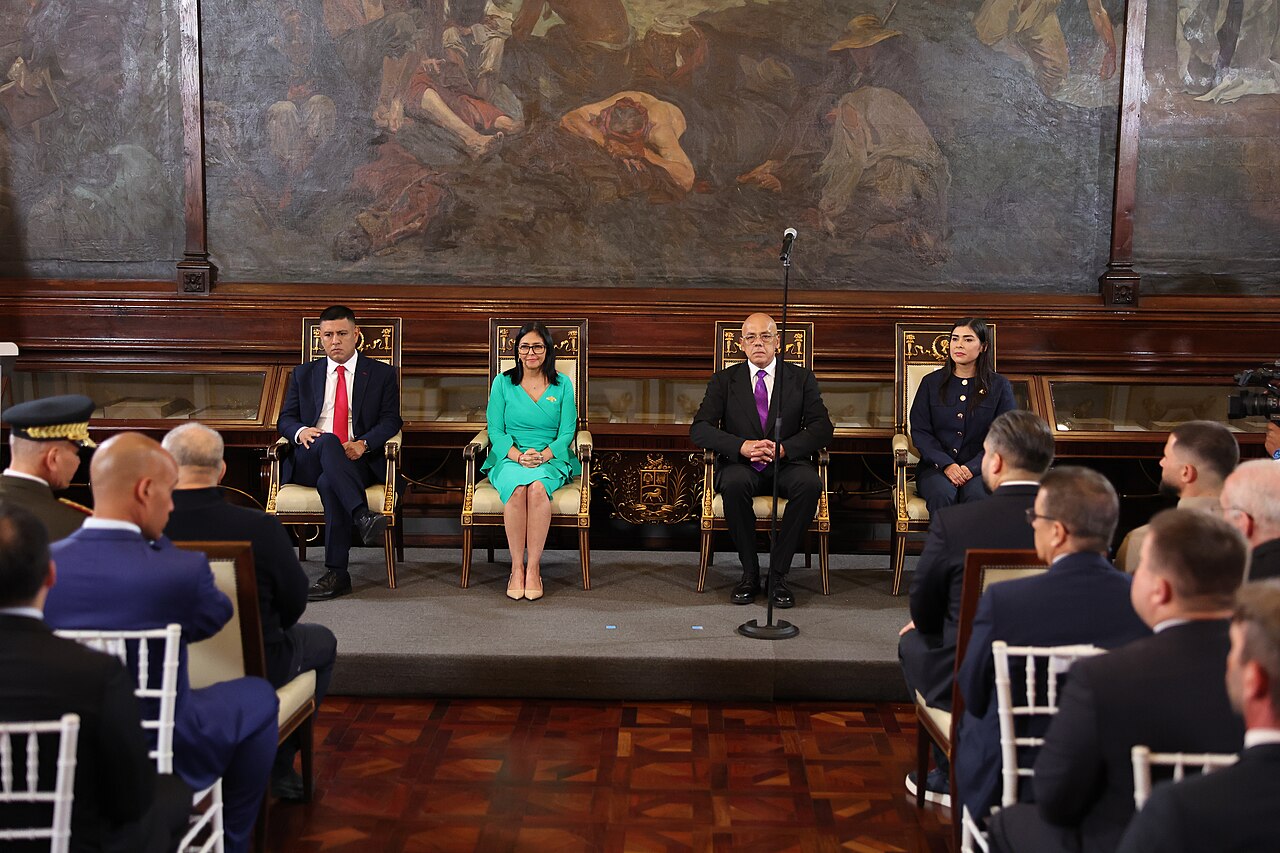
Three months after U.S. special forces captured Nicolás Maduro, his hand-picked successor is dismantling the regime she once served. Acting President Delcy Rodríguez has removed Venezuela's longtime defense minister, replaced all senior military commanders, and opened the country's oil sector to American investment — actions that came only after Washington demonstrated it could deliver consequences.
The U.S. Treasury removed Rodríguez from its sanctions list on April 1, following cabinet changes she announced in March that stripped Maduro loyalists of power. It marks the culmination of a transformation triggered by military pressure and economic sanctions that achieved in months what decades of diplomatic engagement could not.
Rodríguez has made at least 13 executive branch changes since taking office in January, including the removal of Defense Minister Vladimir Padrino López after his 11-year tenure. She replaced all three service branch commanders — Army, Navy, and Air Force — in a March 20 announcement. The sweeping purges follow the Jan. 3 U.S. military operation "Absolute Resolve," which captured Maduro and his wife, Cilia Flores, and left at least 40 Venezuelan civilians and 32 Cuban soldiers dead.
The sanctions relief marks a dramatic reversal for Rodríguez, who was added to the U.S. Specially Designated Nationals list in September 2018 for "undermining democracy." Her removal from that list came as a direct reward for cooperation with Washington. "President Trump's decision is a significant step in the right direction to normalize and strengthen relations between our countries," Rodríguez stated on April 1.
Economic opening accompanied the political restructuring. Venezuela's National Assembly passed reforms to the Organic Hydrocarbons Law on Jan. 29 to attract private investment. The U.S. Office of Foreign Assets Control lifted sanctions on state oil company PDVSA in March, allowing direct sales to American companies. Venezuela signed a $500 million oil sales agreement with the U.S., with President Donald Trump promising $100 billion in investment from major oil companies.
Rodríguez replaced hardline Chavista officials with what she described as "technically skilled" loyalists. She appointed electrical engineer Rolando Alcalá as Energy Minister, academic Ana María Sanjuan as Higher Education Minister, and labor specialist Carlos Alexis Castillo as Labor Minister. Padrino López, for his part, was measured in departure: "It has been the highest honour of my life to serve my country as a soldier," he stated upon his replacement.
Human rights groups note limits to the reforms. Rodríguez appointed Gustavo González López as the new Defense Minister, a figure sanctioned by the Obama administration in 2015 for alleged human rights violations. González López previously served as director of Venezuela's intelligence service Sebin from 2014 to 2018, and again from 2019 to 2024. The human rights watchdog Provea called the appointment a "recycling of impunity."
The U.S. approach contrasts sharply with the European Union's strategy. Washington reopened its embassy in Caracas in March after a seven-year closure, while the EU maintains sanctions imposed in 2017. The divergent outcomes suggest U.S. pressure extracted concessions that Europe's softer approach could not.
Rodríguez's 90-day interim term expired on April 3, leaving Venezuela's political future uncertain. Opposition leader María Corina Machado met with Secretary of State Marco Rubio in March to discuss eventual elections. "Ultimately, there will have to be a transition phase," Rubio stated. "There will have to be free and fair elections in Venezuela, and that point has to come."
With the world's largest proven oil reserves at 303 billion barrels, Venezuela's economic potential drove the restructuring. Oil production collapsed from 3.5 million barrels per day in 1997 to 0.9 million by 2024, crippling the socialist economy. The U.S. military operation signaled Washington's willingness to enforce consequences, with Trump warning Rodríguez on Jan. 4, "If she doesn't do what's right, she is going to pay a very big price, probably bigger than Maduro."
Maduro faces drug trafficking charges in New York federal court, where he pleaded not guilty in January. The operation that captured him involved 150 aircraft and electromagnetic warfare to disable Venezuelan air defenses. His forced removal created the political space for Rodríguez's restructuring.
The changes come as Venezuela grapples with a humanitarian crisis that has driven 7.9 million people to flee since 2014. Fifty-six percent of remaining Venezuelans live in extreme poverty, with 40 percent experiencing food insecurity. Public sector workers earn roughly $160 monthly, while private sector wages average $237 annually.
Washington's recognition of Rodríguez as Venezuela's "sole Head of State" on March 5 formalized the diplomatic shift. Trump praised Rodríguez in March, stating, "Delcy Rodríguez, who is the president of Venezuela, is doing a great job, and she is working very well with the representatives of the United States."
Whether Rodríguez's changes represent genuine reform or pragmatic survival remains uncertain. What the swift concessions reveal, after years of diplomatic stalemate, is that hard pressure moved a socialist government where softer approaches had failed — and for the 7.9 million Venezuelans who fled, the question of whether those changes hold is anything but abstract.