Belfast Erupts in Violence After Asylum Scheme Loophole Exposed
Two nights of Belfast riots claiming 16 arrests and injuring 12 officers followed a knife attack by a man who entered through an unchecked border and received asylum via a questionnaire, exposing critical policy failures.
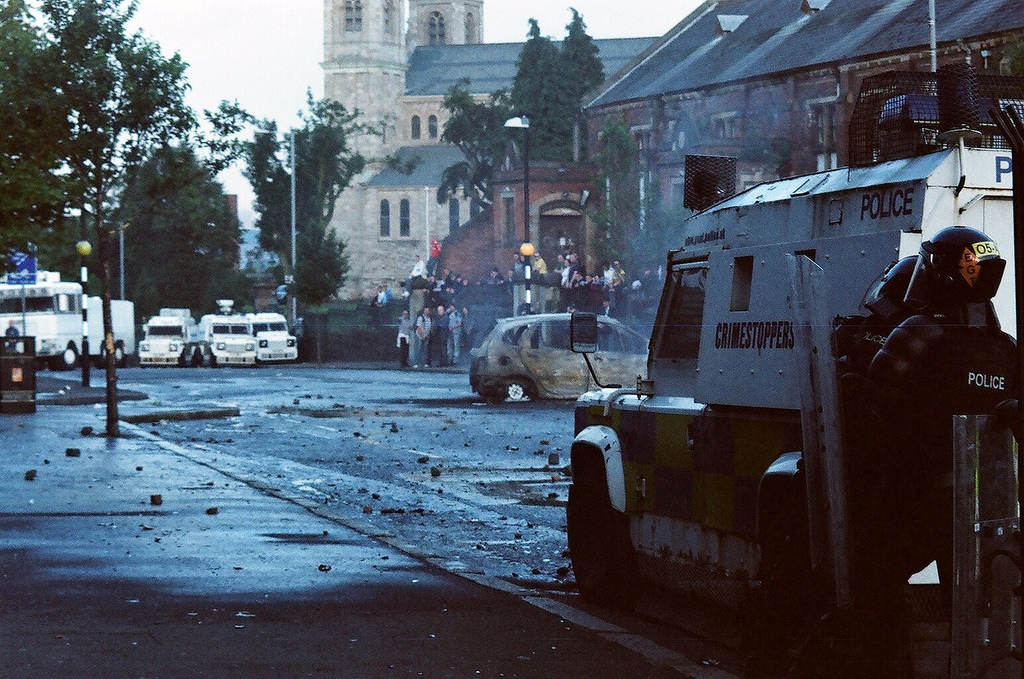
Water cannons sprayed into the Belfast night on June 9 as petrol bombs arced over Sandyknowes roundabout. Masked men torched homes across east Belfast, forcing families including a 2-month-old infant to flee burning buildings. Police rescued terrified residents from addresses listed on a hit list circulating on X. Sixteen arrests. Twelve officers injured. Two nights of chaos.
The unrest erupted after a knife attack on June 8 left Stephen Ogilvie, a man in his 40s, without his left eye and with deep slash wounds to his face, neck, and back. The violence that consumed Northern Ireland traced back to a Home Office questionnaire that granted refugee status to Hadi Alodid, the attack's suspect. An open border with no checks then allowed him through.
Alodid, 30, traveled from Dublin to Belfast on Feb. 10, 2023, crossing through the Common Travel Area that maintains no identity checks between the UK and Ireland. He faced no scrutiny at the border. PSNI Chief Constable Jon Boutcher confirmed the man left "no trace of this suspect on any of our national security databases and he was not known to the Police Service of Northern Ireland."
Alodid later secured refugee status through Rishi Sunak's Streamlined Asylum Process, which replaced face-to-face interviews with a 10-page questionnaire for Sudanese nationals. Home Office civil servants warned the system in 2023 would fail to identify terrorists and serious offenders. The program achieved a 95 percent approval rate at initial decision. More than 5,500 Sudanese main applicants received protection under asylum decisions in the year to March.
"I've killed someone, I don't know if they are dead," Alodid said while in hospital after the attack, according to court testimony reported by the Irish Times. He threatened medical staff with "I will kill you" while receiving treatment for a hand injury. Bystander Maitiu Mág Tighearnán, 32, intervened with his son's hurling stick and struck Alodid multiple times.
"It was my 'natural reaction' to step in," Mág Tighearnán told the Daily Mail. He later told Good Morning Britain that the £30,000 raised for him through GoFundMe should go to the victim instead. The courage of ordinary citizens stepping into danger underscored the breakdown of official security systems.
Tuesday night saw hundreds of masked men attack a Middle Eastern supermarket, trash a Turkish barbershop, and torch vehicles including a Department for Infrastructure truck. Wednesday brought water cannons, rubber bullets, and a rioter who set himself on fire while throwing a petrol bomb. Ofcom warned some disorder "appears to have been incited online."
Tommy Robinson posted attack footage from Moscow. Elon Musk amplified protest calls to 240 million followers. Prime Minister Keir Starmer condemned the violence but offered no explanation of why an attempted murderer received refugee status through a questionnaire. Shadow Home Secretary Chris Philp called for banning asylum claims by illegal immigrants entirely.
"This appalling case shows why no illegal immigrants should even be able to apply for asylum, let alone receive it," Philp told the Daily Mail. DUP leader Gavin Robinson asked Starmer to close the Common Travel Area. Political responses emerged as Belfast still smoldered.
Northern Ireland remains one of Britain's least ethnically diverse regions at 97 percent white according to the 2021 census. Immigration-driven unrest has become a pattern rather than an anomaly. The 2025 Ballymena riots over Romanian Roma teenagers left 107 police injured and forced two-thirds of the local Roma population to flee.
The national terrorism threat level stands at SEVERE. Former counter-terrorism head Neil Basu now ranks far-right agitation over migration as Britain's biggest national security threat, exceeding Islamist terrorism. The violence in Belfast reflected deeper structural anxieties about who enters British communities and under what conditions.
"This raises serious questions over the immigration and asylum policy of successive governments of all parties," Dr. Rakib Ehsan of Policy Exchange told the Daily Mail. He noted that efforts to streamline decision-making processes to reduce the backlog have risked undermining public security of local communities across the home nations. The warning came as officials still had not addressed the policy gaps that enabled the crisis.
Jonathan Hall KC, independent reviewer of terrorism legislation, framed the issue in national security terms on BBC Radio 4. "It does raise the question if certain countries are more likely either to commit very serious offences or to get involved in state threat activity, do we need to start thinking about migration now not simply in terms of the economy or housing but also in terms of national security?" Hall called the situation "destabilising to the nation." He noted people "who happen to be black and brown but are as British as you or me" now feel unable to go about their business.
Security Minister Dan Jarvis has begun internal talks about weaknesses in the Common Travel Area. Aontú party leader Peadar Tóibín called for an Irish sea border with identity checks. The riots exposed what Steve Bannon called Britain's "tripwire" moment on his War Room show. The former Trump strategist warned "these are tough hombres" who "are not going to sit there and tolerate this continually."
As Belfast smolders, the structural failures remain unaddressed. The Streamlined Asylum Process continues processing claims through questionnaires rather than interviews. The Common Travel Area maintains its open border. The cycle that began with a knife attack on Kinnaird Avenue and ended with a city in flames waits to repeat.